Key Takeaways
- Airblast AFC designs blast room systems around the workpiece, abrasive media, production targets, and site conditions.
- Effective airflow, dust collection, lighting, room lining, and abrasive recovery work together to support consistent surface preparation.
- Airblast AFC offers modular, weatherproof, containerized, plastic media, and kit-form blast room options.
- A detailed Blast Room request helps identify the right enclosure, recovery method, ventilation approach, and finishing support equipment.
- Blast room engineering is part of a broader safety program that also requires training, maintenance, exposure controls, and appropriate personal protective equipment.
How Can Airblast AFC Improve Blast Room Performance?
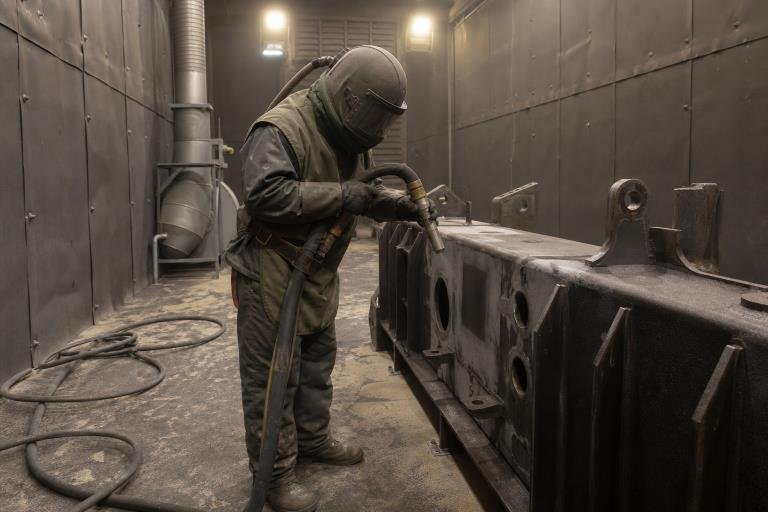
Industrial blasting should not take place in a space that merely contains abrasive material. A productive facility must help operators see the work surface, move safely, maintain equipment, recover usable media, and prepare parts consistently for coating or further processing. Airblast AFC approaches these needs as connected design requirements rather than separate equipment purchases.
For facilities dealing with airborne dust, poor visibility, abrasive accumulation, or uneven surface preparation, an engineered Blast Room can create a more controlled production environment. Airblast AFC provides systems that combine enclosure design, ventilation, dust extraction, lighting, protective lining, blast equipment, and media recovery options.
The right configuration depends on what is being blasted and how often it is blasted. A compact fabricator processing repeat parts has different needs from a marine operation handling large steel structures or an aerospace team using sensitive media. Airblast AFC can tailor room dimensions, access arrangements, abrasive recovery, and environmental controls to each job rather than forcing every project into a standard booth.
Why Do Industrial Blasting Operations Struggle With Dust and Visibility?
Blasting produces a demanding environment. Abrasive particles, coating residue, corrosion products, and surface contaminants can become airborne quickly. When airflow and collection equipment are poorly matched to the enclosure, dust can obscure surfaces, reduce the effectiveness of lighting, create cleanup work, and migrate toward doors or adjacent areas.
Common Problems Inside Underperforming Blast Rooms
- Dust accumulates in the operator’s work zone, making the surface harder to inspect.
- Spent abrasive mixes with contaminants, reducing the quality of reusable media.
- Floor cleanup takes time away from productive blasting.
- Inadequate access, door design, or loading arrangements slow material movement.
- Repeated abrasive impact damages unprotected room surfaces.
- Inconsistent conditions lead to a variable surface profile before painting or coating.
Airblast AFC addresses these issues through purpose-built room construction, durable rubber lining, blast-resistant lighting, dust collection, and recovery equipment. These features support a cleaner, more manageable process, but they do not replace respiratory protection, exposure evaluation, operator training, or a site-specific safety program.
How Does Airblast AFC Design for Specific Applications?
Airblast AFC starts with the operating process. The design team can evaluate workpiece dimensions and weight, available floor area, ceiling height, loading methods, media selection, blasting volume, and the next stage of finishing. This helps determine whether the project needs a basic booth, a transportable enclosure, or a large, integrated blast-and-paint facility.
Important Design Inputs
- Workpiece size and shape:Small fabricated parts, vehicles, rail equipment, vessels, turbine components, and large structures require different clearances and access.
- Blasting process:Grit blasting, shot blasting, bead blasting, shot peening, and plastic media blasting place different demands on the room and recovery system.
- Installation conditions:Indoor, outdoor, temporary, movable, and transportable applications need appropriate construction and utility planning.
- Production rate:Throughput affects room layout, media handling capacity, dust collector sizing, and loading strategy.
- Finishing requirements:Climate control, coating preparation, painting, curing, and corrosion protection may need to be coordinated with the blasting process.
Which Airblast AFC Blast Room Format Fits the Project?
Airblast AFC offers several room formats, each suited to different operational priorities:
- Modular blast rooms:A flexible option for custom indoor installations and larger facilities. Airblast AFC uses galvanized panel construction and protective rubber lining for durability in harsh blast environments.
- Weatherproof blast booths:Useful when indoor space is limited. These insulated, demountable systems can be used outdoors and may reduce the need for permanent construction.
- Containerized blast rooms:A practical choice for fast deployment, transportable operations, or all-in-one setups that integrate major blast room components.
- Plastic media blast rooms:Designed for operations that require plastic media and careful handling of more sensitive surfaces.
- Kit-form blast booths:A value-focused option for organizations seeking standard sizes and simplified installation, including self-assembly options where appropriate.
How Does Airblast AFC Manage Dust and Airflow?
Airflow is central to blast room performance. Airblast AFC designs air-entry and exhaust pathways to move dust-laden air toward collection equipment while preserving visibility around the work. Equipment layout, inlet placement, room volume, abrasive type, and the location of doors or openings all affect whether the system performs as intended.
Applicable regulations matter as much as equipment selection. OSHA abrasive blasting ventilation requirements address exhaust ventilation, dust collection, abrasive separation, enclosure openings, and respiratory protection for blasting operations. A properly designed room should be evaluated alongside the facility’s maintenance procedures, respiratory protection program, and operating practices.
Dust-Control Features to Consider
- Integrated or external cartridge dust collectors.
- Placement of the air inlet and exhaust is suited to the room geometry.
- Blast-proof lighting that improves visibility at the work surface.
- Separation of dust and fines from reusable abrasive.
- Controlled access, interlocks, and durable doors on suitable systems.
How Does Airblast AFC Reduce Abrasive Waste?
Abrasive recovery can make a significant difference in daily workflow. Rather than relying solely on manual collection, Airblast AFC can integrate recovery equipment that moves spent media from the floor, separates usable abrasive from dust and contaminants, and returns suitable material to the blasting process.
Potential benefits include less floor cleanup, more consistent media condition, lower handling demands, and more time available for blasting. Actual operating results depend on the media, workpiece contamination, blasting practices, maintenance, and equipment configuration. Containerized systems can also combine recovery, dust extraction, lining, lighting, and access controls into one coordinated package.
Which Industries Use Airblast AFC Blast Rooms?
Airblast AFC supports facilities with very different sizes, production goals, and quality requirements. Marine and offshore wind projects may require large climate-managed facilities for corrosion control and coating preparation. Aerospace and defense applications can require carefully controlled environments for specialized processes. Automotive, rail, manufacturing, oil and gas, and heavy fabrication operations often need repeatable workflows, robust recovery, and reliable dust management.
For every sector, the practical objective is similar: create a controlled blasting environment that supports surface quality, efficient material handling, and dependable production. Airblast AFC can align the room with the larger finishing process, including painting, curing, access equipment, and future capacity needs.
What Should Buyers Include in a Blast Room Request?
A thorough Blast Room request gives Airblast AFC the information needed to recommend a suitable solution. Include the following details when beginning a project discussion:
- Maximum workpiece length, width, height, and weight.
- Materials, corrosion, coatings, or contaminants to be removed.
- Preferred abrasive media and whether it will be reclaimed.
- Expected daily or weekly production volume.
- Indoor or outdoor installation location, floor space, ceiling height, and utility availability.
- Loading requirements, such as overhead rails, forklifts, side doors, or vehicle access.
- Dust collection, recovery, painting, curing, and climate-control needs.
- Installation schedule, budget considerations, and future expansion plans.
Buyers should also request equipment specifications, airflow information, maintenance requirements, installation responsibilities, and guidance on operator training. NIOSH’s abrasive blasting guidance reinforces why isolation, ventilation, respiratory protection, and safe operating practices must be considered together.
Frequently Asked Questions
Can Airblast AFC build a custom blast room?
Yes. Airblast AFC designs blast rooms around the workpiece, blasting method, site layout, production volume, and finishing requirements.
What is the best option for a small facility?
Kit-form, containerized, or weatherproof systems may suit smaller or space-limited operations. The best choice depends on media, throughput, workpiece size, and installation conditions.
Can an Airblast AFC blast room be installed outdoors?
Yes. Weatherproof blast booths are designed for outdoor applications where a movable, insulated, or demountable facility is needed.
How does Airblast AFC improve blast room visibility?
Airblast AFC combines engineered airflow, dust collection, lighting, room protection, and media management to help reduce airborne dust and improve the operator’s view of the work surface.