Almost every homeowner has stood in the cleaning products aisle holding a bottle of drain cleaner, thinking, “This should fix it.” Sometimes it does. But when the same drain keeps slowing down week after week, or the plunger becomes a permanent bathroom fixture, the problem is usually deeper than any chemical can reach. That’s when it’s time to stop pouring money down the drain, literally, and start thinking about rooter services instead.
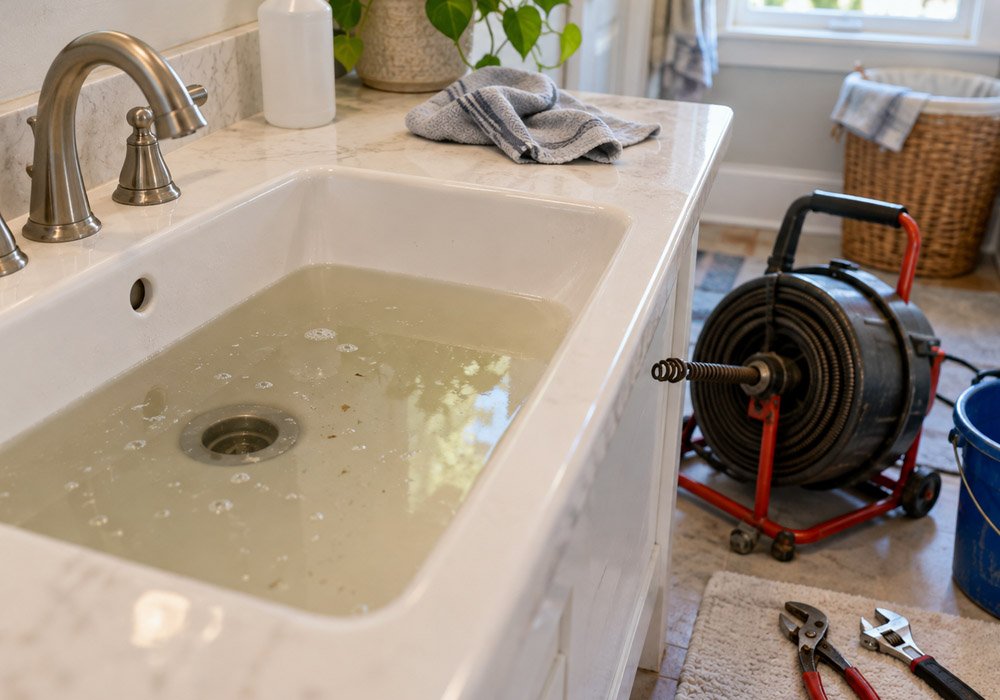
A rooter service is professional drain and sewer line cleaning. The name comes from the original machines designed to cut tree roots out of sewer pipes, and modern versions use motorized cables, blades, and high-pressure water to clear blockages that no store-bought product can touch. The key word here is “clear.” Chemical cleaners attempt to dissolve a clog. A rooter machine removes it, along with the buildup clinging to the pipe walls.
So how do you know when you’ve crossed the line from a normal clog to a job for the professionals? Here are six signs.
1. The Same Drain Clogs Over and Over
One clog is normal. Hair, soap scum, and food debris happen. But a drain that clogs every few weeks, even after you clear it, is telling you something important: you’re treating the symptom, not the cause.
Recurring clogs usually mean there’s a persistent obstruction further down the line. It could be a buildup of grease that has hardened along the pipe walls, a section of pipe that has shifted or collapsed, or tree roots that have grown into a joint and keep regrowing no matter what you pour down the drain. Chemical cleaners can eat a small hole through this kind of blockage, which is why the water flows again for a while. But the hole closes up, and the clog returns.
When a drain clogs three or four times in a season, the pattern itself is the diagnosis. A professional can run a cable through the full length of the line and find out what’s actually down there.
2. Multiple Drains Are Slow at the Same Time
This is one of the most useful signs homeowners can learn to recognize, because it tells you where the problem is located.
If your kitchen sink is slow but the bathroom drains fine, you probably have a localized clog in the kitchen line. Annoying, but simple. But if the sink, the shower, and the toilet are all draining slowly at once, the blockage isn’t in any of those individual drains. It’s in the main line they all feed into.
A main line clog is a bigger deal. Everything in your house is trying to squeeze past the same obstruction, and eventually it won’t. When a main line fully stops up, water has nowhere to go except back up into the lowest fixture in the house, which is usually a shower drain, a basement floor drain, or a downstairs toilet. If you’re noticing multiple slow drains, don’t wait for that moment. This is exactly the situation rooter equipment is built for, because the main line is too long and too deep for any DIY method to reach effectively.
3. Your Toilet Gurgles (And Not Just After Flushing)
A gurgling toilet is one of those sounds that’s easy to ignore once you’ve heard it a few times. Don’t.
That gurgle happens when air is trapped somewhere in the line. As water tries to move past a partial blockage, it forces air pockets backward through the system, and the toilet is often where you hear it. In some cases, the air is coming from the vent stack, which can also be blocked by debris or a bird’s nest.
Either way, a gurgling toilet means the system isn’t venting and draining the way it should. It’s often the last warning you get before a backup. If the gurgling happens when you run the washing machine or drain the tub, that’s an especially strong sign the main line is partially obstructed, since water from one fixture is pushing air and water backward toward another.
4. Water Backs Up in One Fixture When You Use Another
This sign goes beyond gurgling. Water that was in your sink comes back up in your shower. You flush the toilet and the tub drain gurgles up dirty water. You run the washing machine and the toilet water level rises.
When fixtures start trading water with each other, the main line is seriously blocked. The water entering the system from one fixture has nowhere to go, so it travels backward through the branch lines and exits wherever it can.
At this stage, stop using water in the house entirely until the line is cleared. Every flush and every load of laundry adds to what’s coming back up. This is a same-day professional situation, and the fix is a proper machine cleaning of the line, not a chemical that has to travel through standing water just to reach the clog.
5. Your Drains Smell Like a Sewer
A rotten smell coming from a drain deserves attention, and the location of the smell tells you a lot.
If the odor comes from one drain, the cause is often simple. The trap under the sink may have dried out, which happens in guest bathrooms and floor drains that rarely get used. Pouring a pitcher of water into the drain usually fixes that.
But a sewer smell coming from multiple drains, or from the area around your house, points to a different problem. Decomposing waste sitting in a partially blocked line produces gas, and that gas works its way back up through your plumbing. On septic systems, strong odors near the yard can also signal a tank that’s full or a line that’s struggling. Either way, odor plus slow drains together is a reliable signal that something is sitting in the line that shouldn’t be, and it needs to be physically removed.
6. Your Yard Has a Suspiciously Green (or Soggy) Patch
This one surprises people, but the evidence of a drain problem often shows up outside the house before it shows up inside.
If a sewer line running under your lawn has a major leak or a serious blockage, the ground above it gets extra moisture and nutrients. The result is a strip of grass that’s noticeably greener and faster-growing than everything around it. In worse cases, the ground becomes soggy or sunken, or you notice standing water on a dry day.
Tree roots are a frequent culprit here. They’re drawn to the moisture around a leaking joint, they grow into the pipe, and eventually they form a dense mat that catches everything flowing past it. This is the classic rooter scenario, the one the machine was invented for. Cutting the roots out of the line restores flow, and a camera inspection afterward can confirm whether the pipe itself needs a repair.
Why Not Just Keep Using Drain Cleaner?
Beyond the fact that chemicals rarely solve the underlying problem, there are two real downsides worth knowing.
First, caustic drain cleaners are hard on pipes. Repeated use can corrode older metal pipes and damage the seals at joints, which turns a clog problem into a leak problem. Second, if the chemical doesn’t clear the clog, you now have a pipe full of harsh, sometimes heated chemical sitting in your plumbing. Anyone who later opens a cleanout or works on that line, including you, has to deal with it. Professionals run into this regularly, and it’s a genuinely unpleasant part of the job.
There’s also a cost argument. A bottle of cleaner every month adds up to a couple hundred dollars a year, spent on a problem that never actually goes away. One professional cleaning that removes the blockage completely often costs less than a year of bottles and actually ends the cycle.
The Bottom Line
Drain problems rarely announce themselves all at once. They whisper first: a slow drain here, a gurgle there, a smell you can’t place. The homeowners who catch these signals early spend the least, because a line that’s partially blocked is a quick job, while a line that’s fully backed up is an emergency.
If any of these six signs sound familiar, put the bottle back on the shelf. The problem in your drain line is mechanical, and it needs a mechanical solution. A professional cleaning clears the entire line, not just a hole through the clog, and it’s the only approach that actually ends the repeat-clog cycle for good.