Key Takeaways
- Guided implant surgery uses three-dimensional imaging, digital planning, and a custom surgical guide to support planned implant placement.
- Advanced Implant Dentistry and Oral Restoration combines surgical planning with restorative planning, helping the team consider the final crown, bridge, or full-arch restoration before surgery.
- Research indicates that fully guided implant placement can improve positional accuracy compared with freehand placement, but guided treatment still has clinical limits.
- Each patient needs an individual evaluation of bone, oral health, anatomy, medical history, and treatment goals.
What Should Patients Know Before Requesting Guided Implant Surgery in Cedarhurst?
Replacing a missing or failing tooth involves more than placing an implant into available bone. The implant must be positioned with the final restoration, bite, surrounding teeth, bone support, and nearby anatomy in mind. At Advanced Implant Dentistry and Oral Restoration, guided implant surgery Cedarhurst patients can pursue a digitally planned approach designed to make placement more controlled and coordinated.
Located at 76 Spruce Street in Cedarhurst, New York, the practice uses computer-guided planning to determine an intended implant position before the surgical appointment. This technology supports clinical decision-making, but it does not replace the experience, diagnosis, or judgment required for successful implant care.
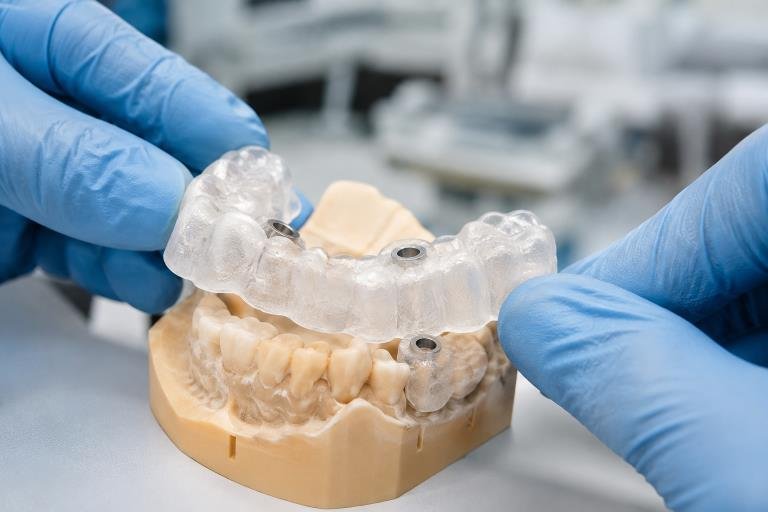
A surgical guide is a custom appliance that fits over the teeth, gums, or jaw. It helps direct the surgical instruments according to the digital treatment plan, including the intended implant position, angle, and depth. The goal is to transfer a carefully developed plan into the clinical setting as consistently as possible.
Guided surgery can be valuable for a single missing tooth, multiple missing teeth, immediate implant cases, and full-arch treatment. Whether it is appropriate depends on the stability of the guide, the patient’s anatomy, the available bone, access during surgery, and the treatment objectives.
How Does Advanced Implant Dentistry and Oral Restoration Plan Guided Implant Surgery?
The process begins with gathering detailed information and planning the restoration as well as the surgery.
Three-Dimensional Imaging and Digital Records
Advanced Implant Dentistry and Oral Restoration uses a RAYSCAN cone-beam CT scanner to capture three-dimensional information about the jaw. This imaging can help the doctors assess bone volume and identify the locations of tooth roots and important anatomical structures. A 3Shape TRIOS intraoral scanner captures digital impressions of the teeth, bite, and surrounding oral structures.
Virtual Implant and Restoration Planning
Using 3Shape Implant Studio software, the doctors can review the scan and digital impression together. This allows the planned implant position to be considered in relation to the intended restoration, rather than treating surgery and the final tooth as separate steps.
Custom Guide Production
After planning, the practice can use its EnvisionTEC Vida 3D printer to produce a patient-specific surgical guide. During placement, the guide helps direct the surgical sequence toward the planned location. The practice also uses restorative design technology and an in-house laboratory for selected implant restorations, which can improve coordination between the surgical and restorative phases.
Why Does Implant Placement Accuracy Matter?
Implant position can affect the appearance, cleanability, bite relationship, and design of the final restoration. It can also influence how the implant relates to available bone and nearby anatomical structures. For these reasons, a prosthetically driven plan focuses on where the replacement tooth needs to function and look its best before the implant is placed.
Guided surgery should not be viewed as a guarantee of exact duplication of a digital plan. Studies measure differences between planned and actual implant positions, including deviations at the implant platform, the implant tip, and the angle. A systematic review comparing guided techniques found that fully guided placement showed greater positional accuracy than half-guided and freehand approaches in the studies it evaluated. Fully guided implant placement showed greater accuracy than half-guided and freehand approaches, although accuracy remains affected by the clinical situation and surgical protocol.
What Does Research Say About Guided Implant Surgery?
Current evidence supports a balanced conclusion: computer-guided implant surgery can improve the accuracy with which a presurgical plan is transferred to the mouth, particularly when a fully guided protocol is used. A review of partially edentulous cases also found that guide manufacturing, the type of toothless space, and the guidance protocol can influence accuracy. Guide design and the clinical setting can influence guided implant accuracy, which is why technology must be matched to the individual patient rather than applied as a one-size-fits-all solution.
- What guided planning can do: Support preoperative planning and improve control of the planned surgical pathway.
- What it cannot do: Eliminate all variation between the virtual plan and the final implant position.
- What still matters: Imaging quality, guide fit and stability, bone density, surgical access, oral health, and clinician judgment.
Who May Benefit From a Guided Implant Surgery Consultation?
A consultation may be appropriate for patients missing one tooth, several teeth, or an entire arch. It can also help patients with failing teeth who are exploring immediate or staged implant treatment, limited bone volume, complex anatomy, or high cosmetic demands in the visible smile zone.
Patients considering a bridge, implant-supported denture, or full-arch restoration may especially benefit from discussing restorative planning early. At Advanced Implant Dentistry and Oral Restoration, the doctors can assess how the final teeth should look and function, then determine whether guided surgery is a suitable way to support that plan.
Can Guided Planning Support Same-Day or Full-Arch Treatment?
Guided planning can support a coordinated workflow for selected immediate and full-arch cases. The practice offers teeth-in-a-day and full-arch implant treatment, using digital records and in-house laboratory capabilities to help prepare temporary restorations when appropriate.
Same-day treatment is not right for every patient. Factors such as infection, bone quality, implant stability, bite forces, smoking, periodontal health, medical history, and the type of planned restoration can change the recommended timing. Some patients may benefit from staged treatment or additional procedures such as bone grafting before restoration.
What Makes This Different From a Technology-Only Approach?
Technology is most useful when it is part of a complete treatment process. Advanced Implant Dentistry and Oral Restoration combines cone-beam imaging, digital impressions, implant-planning software, 3D-printed guides, restorative design, and in-house laboratory support. Dr. Michael Klein has been involved in computer-guided implant technology and holds patents in the field, while Dr. Allon Waltuch brings implant and aesthetic dentistry training to the planning process.
This combination helps the team consider both the surgical and restorative sides of implant care. Sedation options, including IV sedation when clinically appropriate, may also be discussed for patients who are anxious about treatment.
Questions to Ask During a Guided Implant Surgery Consultation
- Is guided implant surgery appropriate for my anatomy and restoration goals?
- Will my procedure be fully guided, partially guided, or use another protocol?
- Will I need an extraction, bone graft, or sinus augmentation?
- How will the final crown, bridge, or full-arch restoration influence implant placement?
- Will I receive a temporary restoration during healing?
- What risks, recovery needs, and follow-up visits should I expect?
Request a Guided Implant Surgery Consultation in Cedarhurst
For patients seeking a more planned approach to implant treatment, Advanced Implant Dentistry and Oral Restoration offers guided implant surgery supported by digital imaging, custom guides, restorative planning, and in-house laboratory coordination. A consultation can clarify whether this approach fits your oral health, anatomy, timeline, and long-term goals for a functional, natural-looking smile.