If you have been in the cigar hobby for more than a year you have probably hit the wall. It is that moment when your desktop humidor is bursting at the seams and your Tupperdors are stacked high in the closet and you realize you are spending more time rotating Boveda packs than actually smoking.
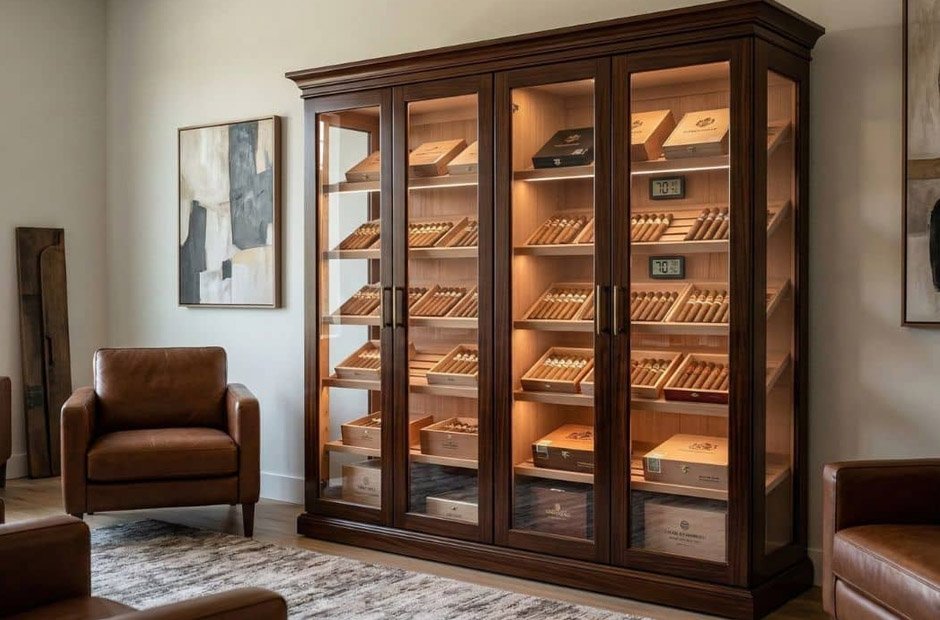
When you decide to level up to a humidor cabinet you are not just buying a piece of furniture because you are investing in an ecosystem. The biggest decision you will face isn’t just about the finish or the glass door but it is about how that cabinet breathes. Specifically do you go with a passive setup or a fully electronic climate control system?
Let us break down the technical realities of both so you can make a choice that does not end in moldy wrappers or dried out wrappers.
Passive Humidification as The Traditional Approach
Passive humidification is what most of us grew up with. It relies on the natural evaporation of water from a source like crystal gels or the industry standard Boveda packs. Please do not use floral foam.
In a large cabinet passive control is a bit like trying to cool a whole house with a single window AC unit. It can work but it is a struggle.
- The Pros: It is silent. There are no fans humming and no sensors to calibrate. If the power goes out your cigars do not care.
- The Cons: Airflow is your enemy. In a tall cabinet humidity naturally wants to settle at the bottom. Without active fans you often end up with seventy two percent RH at the base and a bone dry sixty two percent at the top. You will find yourself constantly rotating your boxes to ensure even aging.
Electronic Climate Control as The Modern Standard
This is where things get interesting for the serious collector. Electronic systems use sensors to monitor the air in real time. When the Relative Humidity drops by even one percent a motorized fan kicks on and draws air through a reservoir or a high tech filter to bump the levels back up instantly.
Most high end humidor cabinets now come equipped with these set it and forget it systems. They do not just manage moisture but they manage temperature which is arguably more important if you live in a climate that swings from humid summers to freezing winters.
Why Active Airflow Matters
The Architecture of Aging is all about consistency. Large cabinets have significant internal volume. Electronic systems use internal circulation fans to keep the air moving twenty four hours a day. This prevents pockets of stagnant air where mold loves to grow. If you are storing thousands of dollars worth of OpusX or aged Padróns that airflow is your insurance policy.
| Feature | Passive Humidification | Electronic Climate Control |
| Precision | High Variance | Extremely Precise |
| Maintenance | High Demand | Low Effort |
| Airflow | Stagnant | Active and Circulating |
| Cost | Lower upfront | Higher upfront |
| Cooling | None | Advanced Options |
The Detroit Winter Factor Integration into the Home
One thing people often forget when buying a large humidor is the environment outside the box. I have seen collectors in the Midwest struggle because their home heating systems strip all the moisture out of the air in January.
If you are living in a place like Metro Detroit you know that home environments are tricky. Whether you are upgrading your current residence or looking at seebhomes.com to find a new property with enough space for a dedicated cigar lounge the room environment is the first line of defense. A humidor cabinet with electronic cooling and heating is essential in regions where the external temperature fluctuates wildly because it prevents the beetle hatching zone of seventy five degrees and the oil drying cold of sub sixty degrees.
Technical Specs to Look For
When shopping do not just look at the shelf count. Check these three specs instead.
- Spanish Cedar Lining It has to be kiln dried Spanish Cedar. It is the only wood that handles high humidity without warping and actually helps regulate the RH naturally.
- Thermoelectric vs Compressor Thermoelectric is quieter and does not vibrate because vibration is bad for long term aging. However compressors are better for very large cabinets in warm rooms.
- Hygrometer Calibration Ensure the system allows for manual calibration. Even the best digital sensors can drift over a year or two.
The Verdict
If you have twenty cigars a passive Tupperdor is fine. But if you are moving into the hundreds or thousands passive control is a headache you do not need.
An electronic cabinet is an investment in peace of mind. You spent years curating your collection so do not let a five dollar humidification puck be the reason it fails. Go electronic and keep the air moving and spend your time enjoying the smoke instead of obsessing over the hygrometer.