Key Takeaways
- Pulling, off-center steering, uneven tire wear, and trailer dog-tracking are practical reasons to schedule an alignment inspection.
- Fleet Alignment Service works with commercial trucks, semi-trucks, trailers, RVs, ice houses, and specialty vehicles.
- A thorough inspection can include measurements of camber, caster, toe, wheelbase, axle tracking, and trailer alignment.
- Alignment works best as part of a broader maintenance approach that also considers tires, steering, suspension, axles, and wheel-end components.
How Can Fleet Alignment Service Help With a Commercial Truck Alignment Request?
Fleet operators experiencing pulling, tire wear, unstable steering, or tracking issues can submit a commercial truck alignment request to Fleet Alignment Service for a professional inspection and adjustment plan. The shop provides commercial truck alignment for large vehicles and trailers, with service focused on correcting conditions that affect handling, tire contact, and axle tracking.
Located at 27540 Forest Boulevard in Wyoming, Minnesota, Fleet Alignment Service serves commercial operators and vehicle owners in communities including Forest Lake, Columbus, Linwood, Stacy, Minneapolis, St. Paul, and nearby areas. Its alignment capabilities cover commercial trucks, semi-trucks, single-, tandem-, and triple-axle trailers, RVs, campers, ice houses, and other specialty equipment.
Alignment is not simply a front-end concern. A complete assessment may involve the relationship between the steering axle, drive axles, and trailer axles. This broader view is important when a tractor-trailer combination does not travel in a straight line as a unit, or when tire wear appears on more than one axle.
Why Does Commercial Truck Alignment Matter to Fleet Operators?
Proper alignment helps tires meet the road more consistently and supports a predictable steering response. When wheel or axle angles are out of specification, a driver may need to make frequent corrections, tires may wear irregularly, and steering or suspension components can experience unnecessary stress.
Alignment is one element of systematic vehicle maintenance, not a replacement for inspections of brakes, tires, suspension, steering, lights, or load-related equipment. Motor carriers targeted for vehicle-maintenance interventions had a 65 percent higher future crash rate than the national average, according to research by the Federal Motor Carrier Safety Administration. That finding supports consistent maintenance practices, but it does not mean alignment alone determines crash risk.
Operators should arrange an inspection when drivers or maintenance personnel notice changes in handling, tracking, or tire condition. Common service triggers include:
- The truck pulls left or right on a level road.
- The steering wheel remains off-center while the vehicle travels straight.
- Steering feels loose, unstable, or requires repeated correction.
- Steer tires show shoulder wear, feathering, cupping, or unusually rapid tread loss.
- A trailer appears to travel at an angle behind the tractor.
- The vehicle has struck a pothole, curb, road obstacle, or uneven surface.
- Steering, suspension, axle, tire, or bushing components were recently replaced.
- Drivers report fatigue associated with maintaining a straight path.
What Does Fleet Alignment Service Check During an Alignment?
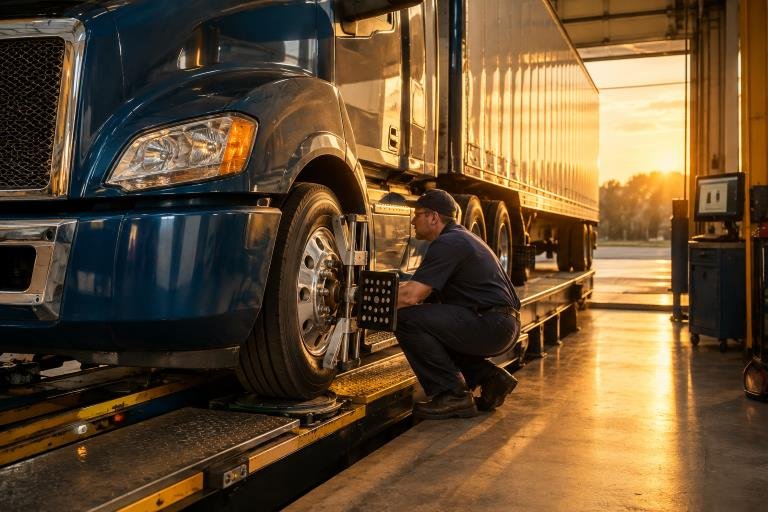
Fleet Alignment Service begins by looking for visible wear, damage, and mechanical conditions that could affect the adjustment or prevent lasting results. Technicians then measure critical wheel-angle settings, including camber, caster, and toe, while also checking wheelbase and axle tracking where applicable.
For commercial trucks, the process may include evaluating the steer-and-drive axle relationships. For trailers, it can include checking whether single, tandem, or triple axles track squarely with the kingpin. Worn bushings, bent parts, loose steering components, or suspension damage may need attention before or alongside an alignment. After adjustments, the vehicle or trailer is rechecked against applicable manufacturer and safety specifications.
Which Vehicles Can Fleet Alignment Service Align?
- Commercial trucks and semi-trucks: Front-end, steer-axle, drive-axle, and full-vehicle alignment for pulling, off-center steering, and irregular tire wear.
- Trailers: Alignment for single-, tandem-, and triple-axle configurations where dog-tracking or abnormal tread wear is a concern.
- RVs and campers: Inspection for drifting, ongoing steering correction, and tire-wear concerns on larger recreational vehicles.
- Ice houses and specialty vehicles: Vehicle-specific assessments for tracking and handling issues related to road impacts or operating conditions.
Why Is Trailer Alignment Important?
A tractor-only inspection may not reveal the source of a combination vehicle’s tracking problem. If trailer axles are not tracking correctly, the trailer may dog-track behind the tractor, contribute to irregular tire wear, or make the driver compensate with steering corrections. A driver may report that the truck pulls, while the underlying concern may be related to trailer alignment, suspension condition, or an axle component.
How Does Alignment Support Tire Life and Road Readiness?
Alignment can help prevent continued abnormal wear when misalignment is the underlying cause. Tire life also depends on inflation pressure, loading, road conditions, driving habits, suspension condition, and the tire itself. The National Highway Traffic Safety Administration notes that rotation, balancing, and alignment can help tires last longer, making routine tire checks a useful complement to alignment service.
For fleet managers, an alignment inspection is a practical opportunity to identify a developing issue before it becomes a larger tire, steering, or suspension repair concern. Service time will vary based on the vehicle configuration, component condition, and whether additional repairs are needed.
When Should a Fleet Operator Request Alignment Service?
- After an impact: Request an inspection after a significant pothole, curb strike, collision, or road hazard.
- After tire replacement or when there are visible tread irregularities, it is an appropriate time to assess alignment.
- After steering or suspension repairs: Repairs that affect wheel position or axle movement may warrant an alignment check.
- When handling changes: Pulling, drifting, vibration, or an off-center steering wheel should be evaluated.
- During preventive maintenance,build alignment checks into the maintenance plan based on use, mileage, road exposure, and manufacturer guidance.
What Should Operators Include in a Commercial Truck Alignment Request?
Providing useful details helps Fleet Alignment Service prepare for the inspection. Include the vehicle type, make, model, year, axle configuration, current symptoms, tire-wear pattern, recent impacts, recent tire or suspension work, and preferred appointment timing. Fleet Alignment Service can also address related needs involving steering, suspension, axle and chassis work, bore and bushing services, U-bolts, welding, trailer repair, DOT inspections, and mobile services.
Frequently Asked Questions
Does Fleet Alignment Service Align Trailers?
Yes. Fleet Alignment Service aligns single-, tandem-, and triple-axle trailers and can assess axle tracking, dog tracking, and tire wear concerns.
Can Alignment Fix Uneven Tire Wear?
Alignment can help stop continued uneven wear when misalignment is the cause. Existing tire damage, incorrect inflation, overloading, and worn suspension parts may also contribute to tread loss.
How Can a Fleet Operator Schedule Service?
Operators can contact Fleet Alignment Service at 651-462-3299 to discuss alignment needs for commercial trucks, trailers, RVs, ice houses, and specialty vehicles.
Conclusion
Fleet Alignment Service provides a focused path for addressing commercial vehicle pulling, uneven tire wear, steering concerns, axle tracking issues, and trailer dog-tracking. A timely inspection, clear symptom history, and attention to related mechanical conditions can help operators make informed maintenance decisions and keep their equipment ready for the road.