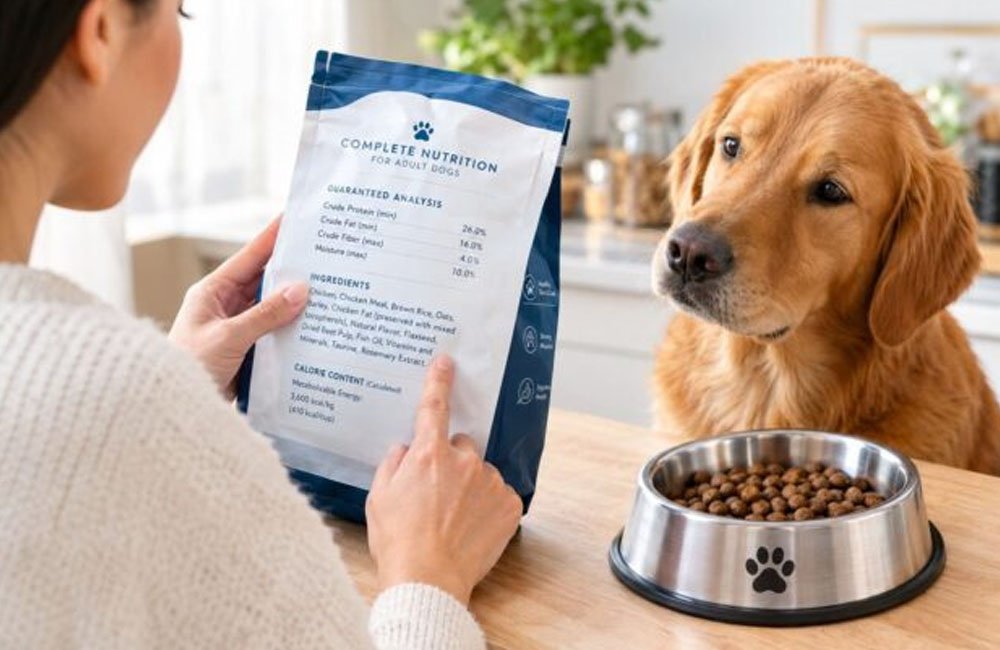
I once stood in a pet store aisle for eleven minutes holding two nearly identical bags of dog food. Same price. Same weight. One said “holistic” in gold foil, the other said nothing fancy at all. I bought the gold one. My dog had digestive issues for a week, and I learned a lesson that cost me about forty dollars in vet visits and one very unhappy carpet.
The front of a pet food bag is advertising. The back is the part that tells you anything true. Once you know which sections to read in which order, the whole thing takes about ninety seconds per bag, and you stop paying extra for adjectives.
What you are actually shopping for is a food that fits your animal’s age, size, and any sensitivities, and the people who are best at spotting the difference between real nutrition and good copywriting are the ones who read the fine print first. Coaches who guide clients through diet and lifestyle decisions, from human meal planning to household habits, tend to teach the same lesson: the label is a document, and documents reward slow reading. Whether you work with a professional or not, that logic holds. If you ever want someone to walk through the details with you, a Nutritionist Park City can help you build that habit of reading past the headline. This guide covers the version you can do alone, right now, in the aisle.
Start With the Guaranteed Analysis, Not the Story
The guaranteed analysis is the small grid that lists protein, fat, fiber, and moisture as minimums and maximums. It is the driest text on the package, which is exactly why it is the most useful. It is also the only part with a legal floor under it; the numbers have to be truthful within stated tolerances.
Two things trip people up here. First, protein minimums are listed by weight, and wet food is mostly water, so a canned food showing 9 percent protein is not worse than a dry food showing 26 percent. Compare within the same format or convert to dry matter basis. Second, the order of ingredients on the label is by weight before processing, so a fresh chicken at the top can shrink dramatically once the water cooks off. That is why “chicken first” is a real signal but a weaker one than most people assume. According to the U.S. Food and Drug Administration, pet food labels follow defined naming and ingredient rules, which is why the wording on the back tends to be more consistent than the wording on the front.
Decode the Ingredient Split
Manufacturers know that splitting an ingredient lets them push it down the list. If a bag lists “ground corn, corn gluten meal, and corn bran” as three separate lines, no single corn entry looks like the main ingredient, even though corn as a category might be. Read the first five ingredients, then mentally group anything that’s clearly the same source. That single habit changes how you see half the bags on the shelf.
What the front-of-bag words actually mean
Some claims are regulated, and some are basically mood lighting:
- “Complete and balanced” means the food meets a recognized nutrient profile, either through formulation or feeding trials. This is the claim that matters most.
- “Natural” has a defined meaning but says nothing about quality or balance.
- “Holistic,” “premium,” and “ultra” have no standard definition at all. They are vibes with a printing budget.
- “By-product” sounds bad and mostly is not, since organ meats are nutrient-dense. Judge the whole formula, not one word.
My rule of thumb: if a claim cannot be tied to a number or a defined standard, it is decoration, and I will not pay more for it. You probably should not either.
Check Who Stands Behind the Formula
This is the step almost nobody takes, and it takes twenty seconds. Look for a manufacturer name and a contact address on the bag, not just a brand logo. Brands that do not own their plants still have to stand behind the formula, but the ones with their own facilities and a named nutritionist on staff tend to answer questions faster when something goes wrong. Send one email before you commit to a forty pound bag. Ask where the food is made and who formulates it. The reply, or the silence, tells you a lot. The Pet Food Institute notes that member companies generally employ veterinary nutritionists and food safety staff, so a name you can trace is a reasonable proxy for accountability.
A Practical Routine You Can Run in the Aisle
Here is the order I use now, and it has never steered me into another bad bag:
- Read the guaranteed analysis first. Check that the protein and fat fit your pet’s life stage and activity level.
- Read the first five ingredients. Group split versions of the same source and see what actually dominates.
- Find the “complete and balanced” statement and the life stage it covers.
- Ignore every adjective on the front panel. Cover it with your hand if you have to.
- Look for a manufacturer name you can contact, then actually contact them once.
- Buy the smallest bag that makes sense, transition slowly, and watch stool, coat, and energy for two weeks.
That last step matters more than any label. Every animal is an individual, and the U.S. Department of Agriculture tracks the broader food supply that feeds both people and animals, but it cannot tell you how your specific dog handles chicken versus lamb. Only your dog can. Keep a two week log, even a messy one in your phone notes, and let the results overrule the packaging.
Where the Bag Ends and Your Judgment Begins
No label tells you everything, and no single ingredient is poison or magic. The pet food aisle rewards readers and punishes impulse buyers, which is a strange thing to say about a category built on affection. But that is the whole game: manufacturers sell to your feelings, and your animal lives with the consequences.
So read the back first. Group the ingredients. Ignore the gold foil. Then buy a small bag and let your dog cast the deciding vote.