Buying in Manhattan is not simply a matter of finding the right apartment. Two homes with similar asking prices can create completely different daily lives because of their blocks, building rules, commute options, noise levels, monthly costs, and nearby services. For buyers looking for informed neighborhood guidance, Harlem, NY real estate experts The Boland Team offer Manhattan-focused property searches, valuation guidance, and market insight for buyers, sellers, and investors. The Boland Team brings local experience across Harlem, East Harlem, Morningside Heights, and other Manhattan neighborhoods, making its perspective useful when comparing the details that can change a purchase decision.
The best neighborhood is not automatically the most famous, trendiest, or least expensive option. It is the place that supports your budget, routine, housing preferences, and plans for the next several years. A disciplined comparison process can help you look past a listing’s photos and decide whether an area truly fits.
Start With a Clear Buying Profile
Before touring neighborhoods, write down the non-negotiables and preferences that will guide your search. Include:
- Your maximum purchase price and preferred monthly housing cost.
- The minimum number of bedrooms and bathrooms you need.
- Your preferred property type, such as a co-op, condo, townhouse, or new development.
- Your acceptable commute time and usual destinations.
- Whether you need an elevator, laundry, outdoor space, storage, parking, or pet-friendly policies.
- Whether you expect to stay for a few years or for the long term.
For example, a buyer working near Midtown may choose a smaller one-bedroom with a direct commute over a larger apartment farther uptown or downtown. More square footage has value, but an easier weekday routine can be worth more over time.
Compare Neighborhoods by Daily Routine
A neighborhood should be evaluated during ordinary life, not only during a polished weekend showing. Visit each serious contender at least twice, preferably at different times.
- Morning:Check subway access, school traffic, street noise, coffee shops, and grocery convenience.
- Afternoon:Notice deliveries, construction activity, foot traffic, and how commercial the block feels.
- Evening:Listen for nightlife, traffic, restaurant noise, and building activity.
- Weekend:Walk to parks, restaurants, cultural destinations, markets, and regular errands.
A calm Sunday afternoon may not reveal a difficult weekday commute or a busy nightlife corridor. Look for the version of the neighborhood you will actually experience most often.
Use a Practical Neighborhood Scorecard
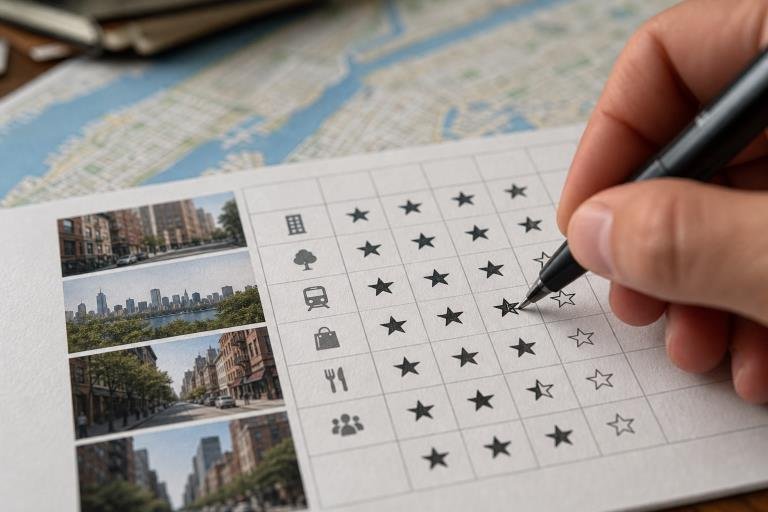
Give every neighborhood a score from one to five in the categories that matter most. This keeps a memorable showing or attractive kitchen from overwhelming the bigger picture.
- Transportation:Can you reach work, school, airports, and family without inconvenient transfers?
- Housing value:What apartment size, condition, and building quality does your budget buy?
- Daily services:Are groceries, pharmacies, parks, gyms, and dining options reasonably close?
- Building options:Does the area offer enough co-ops, condos, townhouses, or newer buildings to create choice?
- Noise and feel:Does the street feel residential, lively, commercial, quiet, or crowded in a way that suits you?
- Future fit:Will the neighborhood still work if your job, household, or lifestyle changes?
Review Market Signals, Not Just Asking Prices
Asking prices are only one data point. Compare active inventory, days on market, price reductions, contract activity, and recent closed sales for similar homes. A 2026 NYC buyer market analysis from StreetEasy, based on December 2025 listing data, illustrates how rising inventory and lower asking prices in certain neighborhoods can give buyers more choices and potentially more room to negotiate.
Also consider whether a neighborhood’s median price is based on a broad number of transactions or a small number of luxury sales. A high median does not always mean every available home is expensive, and a lower median does not guarantee a low-cost ownership experience.
Look Beyond the Purchase Price
A lower price can become less appealing when the building carries high monthly expenses or requires substantial work. Compare the full cost of ownership, including:
- Common charges or co-op maintenance.
- Property taxes and any tax abatements.
- Potential assessments, capital projects, and building reserves.
- Renovation needs, repair costs, and lender requirements.
- Co-op financial standards and board approval expectations.
- Subletting, pied-à-terre, pet, and renovation rules.
Check Transportation and Building Quality
Map your real travel patterns during peak hours. Check subway entrances, bus routes, walking distances, bike access, and late-night reliability. Ask whether a commute will still work if you change jobs or need to reach schools, parks, hospitals, or relatives more often.
Then investigate the building as carefully as the block. Review available board minutes, recent repairs, insurance matters, pending assessments, staff levels, investor ownership, and any history of litigation. A desirable location cannot fully offset weak building finances, restrictive policies, or poorly maintained systems.
Watch for Neighborhood Change
Planned construction, zoning proposals, transit work, retail openings, school changes, and public projects can affect future convenience, traffic, noise, and demand. Verify the status, funding, approvals, and expected timing rather than assuming every announcement will be completed quickly. Recent NYC neighborhood sales data also shows why transaction volume should be considered alongside sale prices. Some areas produce many more comparable sales, while luxury districts may show high median prices from relatively few closings.
Common Buyer Questions
Which Manhattan neighborhood is best for a first-time buyer?
There is no universal answer. Budget, financing, building type, monthly costs, commute, and expected ownership length should lead the decision.
Should buyers choose the most popular neighborhood?
Popularity can support demand, but it can also bring higher prices and more competition. A nearby neighborhood with similar transit and services may offer stronger value.
Is a condo better than a co-op?
Neither is automatically better. Condos may offer more resale and subletting flexibility, while co-ops often have distinct approval and financing rules. Building-specific policies matter most.
How many neighborhoods should buyers compare?
Start with three to five. Too few can limit your options, while too many can make meaningful comparisons difficult.
A Simple Decision Process
- Set a complete budget that includes monthly and closing costs.
- Choose your top three lifestyle priorities.
- Select three to five neighborhoods to investigate.
- Visit each one at different times of day.
- Compare current listings, recent sales, building fees, and rules.
- Revisit the strongest choices before making an offer.
Final Takeaway
The right Manhattan neighborhood is the one that works in real life, not just on paper. By comparing daily routines, full ownership costs, transportation, building health, market conditions, and future needs, buyers can move from a broad search to a more confident and durable decision.