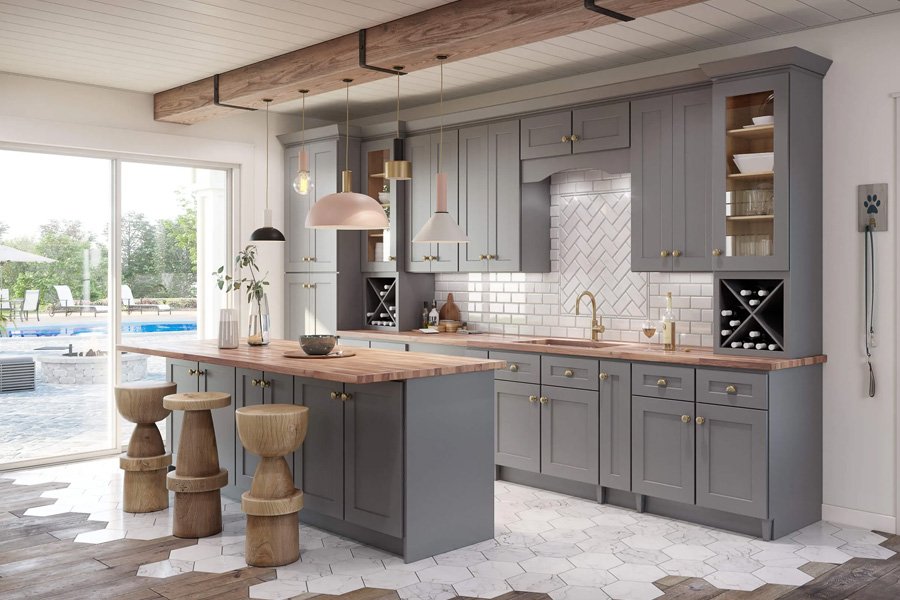
Walk into any kitchen built in the last 150 years and you can usually guess its age before you see anything else. The cabinets give it away. Cabinet design tracks closely with the broader design movements of each era, and understanding that history is more than trivia. If you are renovating, restoring, or simply trying to figure out what look you actually love, knowing the origins of different kitchen cabinet styles helps you make choices that feel intentional rather than borrowed.
Here is a walk through the major design eras and the cabinet looks that defined them.
The Shaker Era: Simplicity as a Philosophy
The Shakers were a religious community that settled in America in the late 18th century, and their furniture philosophy was radical for its time: everything unnecessary was removed. Their cabinet doors featured a flat center panel surrounded by a simple frame, no ornamentation, no carvings, no fuss. Just clean lines and honest joinery.
What started as a matter of religious principle became one of the most enduring cabinet designs in history. The Shaker door profile is still the single most requested style in kitchen renovations today, and it is easy to see why. It reads as warm and handmade in a farmhouse kitchen, yet restrained enough to feel current in a modern one. Few designs can stretch across that many aesthetics without changing a thing.
If you have heard the term “farmhouse Shaker,” that refers to the pairing of this door profile with rustic elements like apron sinks, open shelving, and muted paint colors. The style became shorthand for comfortable, unpretentious living, and it still dominates rural and suburban renovations alike.
The Victorian Kitchen: Cabinets Before Cabinets
Victorian kitchens of the late 1800s did not really have cabinets in the way we think of them now. Storage meant freestanding cupboards, pantries, and pie safes, often built by local carpenters with whatever wood was available. These pieces were tall, dark, and solid, sometimes with punched tin panels in the doors to let air circulate around baked goods.
The Victorian influence survives today in the form of furniture-style cabinetry. Freestanding island bases, glass-fronted display cupboards, and cabinets with feet or decorative corbels all trace back to this era, when kitchen storage was literally furniture rather than built-in architecture.
Early 1900s to the 1930s: The Hoosier and the Birth of Built-Ins
The early 20th century brought the Hoosier cabinet, a freestanding all-in-one workstation with flour bins, sugar sifters, and a pull-out work surface. It was a commercial product, mass-produced, and it changed how American kitchens functioned.
By the 1920s and 30s, kitchens began to be designed as unified rooms with built-in cabinetry along the walls. This is the moment the modern kitchen really takes shape. Cabinet fronts from this period favored simple recessed panels, often painted in cream, soft green, or the occasional bold period color. Glass doors with mullions became common for displaying dishware, a detail that has come back into fashion more than once since.
Mid-Century Modern: Flat Fronts and New Materials
After World War II, everything changed. The postwar building boom created demand for kitchens that were fast to manufacture and easy to clean, and the slab door was born. A completely flat front with no frame, no panel, no profile. Just a clean rectangle.
Mid-century cabinet design embraced new materials too: plastic laminates in bold colors, blonde woods like birch and light oak, and metal cabinets in cheerful reds and mint greens. The look was optimistic and unfussy, a deliberate break from the heavy woodwork of earlier decades.
The slab door remains the foundation of every minimalist kitchen built today. If you have ever admired a sleek handleless kitchen with seamless fronts, you are looking at a direct descendant of 1950s design, just with better hinges.
The 1970s and 80s: Wood Grain Takes Over
This era gets mocked a lot, but it deserves an honest mention. The 70s and 80s were all about visible wood grain, with oak and walnut dominating American kitchens. Dark stained raised-panel doors, ornate crown molding, and valances over the sink were everywhere.
Some of it has aged poorly. But the era’s core idea, letting the natural material be the star rather than paint, is having a genuine revival right now. Today’s version favors lighter species like white oak, cleaner door profiles, and matte finishes instead of the heavy gloss of decades past. The lesson from this era is that the material was never the problem. The execution was.
The 1990s and 2000s: Raised Panels and the Tuscan Wave
The raised-panel door, with its center panel that pops outward in a sculpted profile, defined this period. Combined with maple or cherry finishes, decorative glazes, and heavy crown molding, the look leaned formal. The late 2000s added the Tuscan trend, with distressed finishes, wine racks, and faux antique details.
This style fell out of favor hard, and many homeowners ripping out these kitchens assume the door profile itself is dated. It is not, quite. The real issue was the layering of so much ornamentation at once. A raised-panel door in a simple paint color with minimal trim reads far more traditional than dated. Still, this era is the one most renovations are currently tearing out, which tells you something about how quickly a heavily trend-driven look can turn.
Modern Minimalist: The Current Standard
Modern minimalist kitchens take the mid-century slab door and refine it. Think full-overlay doors with nearly invisible gaps, integrated finger pulls instead of hardware, and continuous surfaces that hide appliances behind matching panels. Colors stay quiet: whites, greys, warm taupes, and increasingly, natural wood tones.
The philosophy here is that the kitchen should recede rather than perform. Storage is concealed, sight lines stay clear, and the few materials used are allowed a lot of visual space. It is a demanding style in one respect, because with so little ornamentation, the quality of the cabinet construction and installation becomes the whole show. A crooked gap or a cheap hinge has nowhere to hide.
Transitional: The Era We Are In Now
The most honest label for the current moment is transitional. Homeowners today rarely commit to one pure style. A Shaker door in a soft greige with brass hardware and a walnut slab island borrows from three eras at once, and it works.
Designers have also started mixing eras deliberately within a single kitchen. Fluted or reeded panels, a texture with roots in much older furniture traditions, now show up on islands and accent cabinets. Glass-fronted uppers nod to the 1920s. Two-tone palettes, one color above and another below, feel fresh but are really just a new spin on very old ideas about contrast.
Using This History When You Renovate
Here is the practical takeaway. When you are choosing cabinets, you are not really choosing a door profile. You are choosing which era’s philosophy fits how you live.
If you want a kitchen that feels warm and forgiving, that can absorb scuffs and changing décor over decades, the Shaker profile is your answer, and it has proven itself across two centuries. If you want a kitchen that feels calm and architectural, where the room itself is the statement, the modern slab approach fits, provided you are willing to pay for the precision it demands. If you love character and a sense of history, furniture-style pieces and glass fronts from earlier eras bring a soul that flat-pack minimalism struggles to match.
The biggest mistake is mixing eras without a filter. A Tuscan glaze next to a handleless slab looks like a renovation that lost confidence halfway through. Pick one dominant philosophy and let the others appear only as accents.
Styles come and go, but the underlying ideas keep circling back. Simplicity, natural material, honest construction. The Shakers built on those principles 200 years ago, and the most admired kitchens being photographed today are built on exactly the same ones. The eras change the details. The good ideas stay.