Essential Digital Resources and Online Tools for Learning Chinese
In August 2026, the landscape of language learning is dominated by sophisticated digital tools that have revolutionized how we approach Mandarin. For professionals aiming to master business Chinese, these resources are indispensable. They offer unparalleled access to authentic language materials, interactive exercises, and personalized learning paths. Whether you’re starting with basic characters or refining your negotiation phrases, the right digital platform can accelerate your progress significantly.
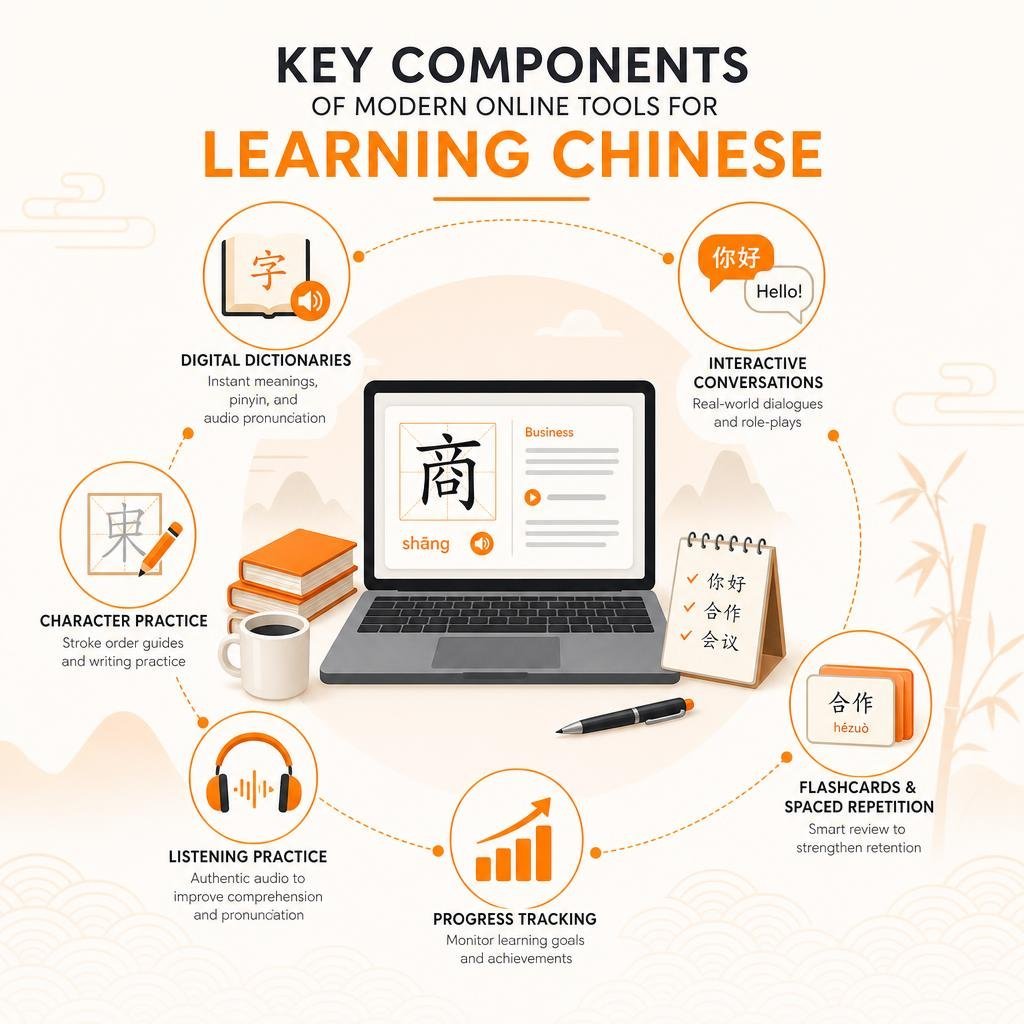
Modern online tools for learning Chinese integrate various functionalities, from comprehensive digital dictionaries and pinyin practice modules to interactive platforms that simulate real-world conversations. Many also offer flashcard integration, leveraging spaced repetition algorithms to optimize vocabulary retention. These tools are designed to cater to diverse learning styles and schedules, making consistent practice both accessible and engaging.
Leveraging Digital Dictionaries and Interactive Platforms for Vocabulary Building
Building a robust vocabulary is the cornerstone of any language acquisition, and business Chinese is no exception. Digital dictionaries go far beyond traditional paper versions, offering instant access to character breakdowns, pinyin pronunciation guides, and native speaker audio resources. This immediate feedback loop is crucial for developing accurate pronunciation and understanding character components, which often hold clues to their meaning.
Interactive platforms further enhance this process by providing contextual examples and usage scenarios. They might present business terms within mock emails, meeting dialogues, or case studies, allowing learners to see how words function in practical settings. Features like spaced repetition, often built into these platforms or available through integrated flashcard systems, ensure that newly learned vocabulary is reviewed at optimal intervals, solidifying memory and moving words from short-term recall to long-term retention. This systematic approach is particularly effective for memorizing key business vocabulary terms such as ‘违约’ (wéiyuē – breaking a contract) and ‘按时’ (ànshí – being on schedule), which are critical for effective corporate communication.
Utilizing Online Tools for Learning Chinese Business Phrases and Etiquette
Beyond individual words, mastering business phrases and understanding cultural etiquette are paramount. Online tools provide structured lessons that delve into corporate vocabulary, negotiation terms, and contract phrasing. They often include modules dedicated to formal greetings, appropriate address forms, and communication protocols specific to Chinese business environments.
For instance, understanding when to use formal versus informal language, or how to politely express disagreement, is a subtle but vital aspect of business etiquette. Digital platforms can offer role-playing simulations, allowing users to practice these interactions in a low-stakes environment. They might present scenarios where you need to ask questions, keep to schedules, or discuss potential contract breaches, providing immediate feedback on your linguistic and cultural appropriateness. By repeatedly engaging with these practical applications, learners can develop the confidence and fluency needed to navigate complex business discussions effectively, ensuring they can express business actions clearly and respectfully.
Key Chinese Business Idioms and Their Modern Applications
Chinese business communication is deeply enriched by the use of chéngyǔ (成语), or four-character idioms. These concise expressions encapsulate centuries of wisdom, historical events, and cultural values, offering profound insights into the Chinese way of thinking. For anyone engaged in economic activity, understanding these idioms is not merely about language proficiency; it’s about grasping the underlying philosophy of investment strategy and commercial communication. In August 2026, while global business practices have evolved, the resonance of these classical phrases in modern corporate discourse remains strong.
Understanding ‘将本求利’ (Jiāng Běn Qiú Lì) and Capital Investment
The idiom ‘将本求利’ (jiāng běn qiú lì) literally translates to “using principal to seek profit.” It describes the fundamental motivation behind commercial operations and financial decisions: the act of investing capital with the expectation of earning a return. This phrase captures the essence of entrepreneurial spirit and sound financial management.
In a business context, ‘将本求利’ is used to articulate the rational pursuit of profit through investment. It implies a calculated approach where initial capital, or ‘本’ (běn), is strategically deployed to generate ‘利’ (lì), or profit. For example, a small business owner opening a new shop does so with the primary goal of ‘将本求利’ – investing their resources to improve their family’s economic situation. Similarly, in corporate finance, this idiom can describe a company’s decision to allocate funds to a new project, expecting a positive return on investment (ROI). It reflects a pragmatic outlook on financial ventures, emphasizing that capital is not merely held but actively used to create wealth. While traditional Chinese culture sometimes viewed commercial activities with moral judgment, ‘将本求利’ stands as a modern, rational term for investment and business, akin to English phrases like “invest to make a profit” or “capital appreciation.”
Unlocking ‘一本万利’ (Yī Běn Wàn Lì) and High ROI Concepts
Another powerful idiom in Chinese business is ‘一本万利’ (yī běn wàn lì), which means “one capital, ten thousand profits.” This vivid expression describes a situation where a small investment yields an extraordinarily large return. It signifies a highly profitable venture, often with minimal capital outlay, making it a dream scenario for entrepreneurs and investors alike.
The phrase breaks down character by character: ‘一’ (yī) for one unit, ‘本’ (běn) for capital or cost, ‘万’ (wàn) for ten thousand or a vast quantity, and ‘利’ (lì) for profit. Together, they paint a picture of immense financial success. Historically, this concept is deeply embedded in Chinese culture, with citations in classical texts like Shi Ji and Song Shi. A famous anecdote involves Lu Buwei, a merchant during the Warring States period, who “invested” in Prince Yiren, helping him ascend to the Qin throne, and ultimately becoming Prime Minister. This legendary “high-return” political deal perfectly illustrates the spirit of ‘一本万利’.
In modern business, ‘一本万利’ is often used to describe high-yield projects, innovative startup ideas with low capital requirements but massive market potential, or highly successful business models. For instance, a market researcher might recommend a new product as ‘一本万利’ after thorough feasibility studies, or a small boutique cafe that requires minimal initial capital but generates continuous, significant profits could be described with this idiom. It evokes positive emotions, symbolizing wit, clever financial decision-making, and encourages a brave approach to business risks, often associated with the excitement of startup culture.
Distinguishing ‘将本求利’ vs ‘一本万利’ in Business Contexts
While both ‘将本求利’ and ‘一本万利’ relate to profit-seeking, they describe different aspects and magnitudes of financial endeavor. Understanding their distinctions is crucial for precise communication in Chinese business.
‘将本求利’ is a broader, more general principle. It describes the fundamental act of investing capital to generate any profit. It’s a statement of intent and a basic economic premise. It doesn’t necessarily imply a massive return, just a positive one. Its focus is on the process of capital deployment for gain.
‘一本万利’, on the other hand, is much more specific and aspirational. It denotes an exceptionally high return on a relatively small investment. It’s about maximizing profit efficiency and achieving disproportionate gains. It often carries a sense of good fortune, shrewdness, or a uniquely advantageous opportunity.
Here’s a table summarizing their key differences:
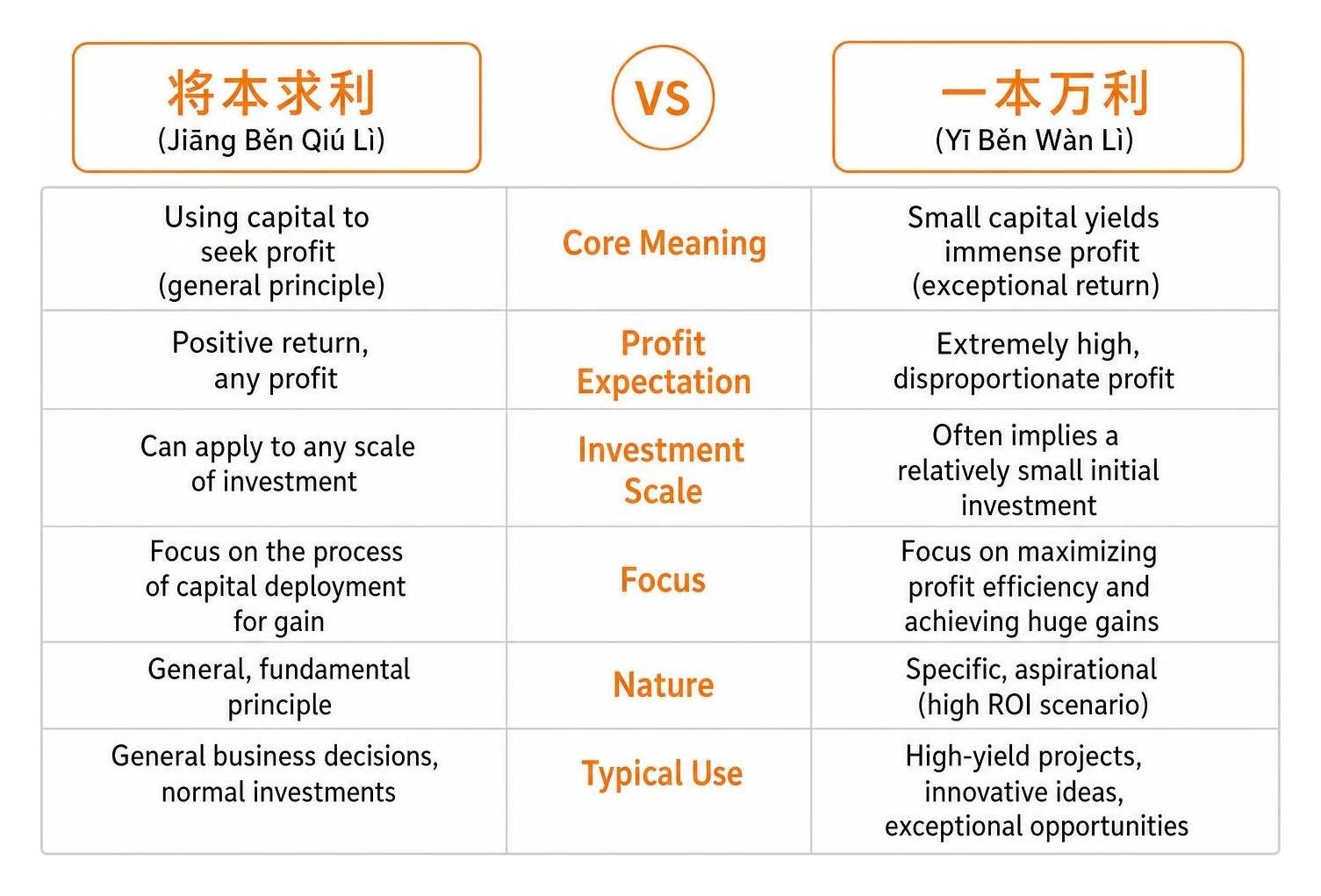
Feature 将本求利 (Jiāng Běn Qiú Lì) 一本万利 (Yī Běn Wàn Lì) Core Meaning Using capital to seek profit (general principle) Small capital yields immense profit (exceptional return) Profit Expectation Positive return, any profit Extremely high, disproportionate profit Investment Scale Can apply to any scale of investment Often implies a relatively small initial investment Risk Profile Standard business risk associated with investment Implies a highly successful, often low-risk (relative to return) venture Usage Context Describes the fundamental motivation of business/investment Highlights extraordinary success or high-potential ventures Emphasis The act of investing for gain The magnitude of the gain ‘将本求利’ is the everyday reality of business, while ‘一本万利’ is the coveted outcome, the highly successful dream project. Both are integral to understanding Chinese business thought, but they serve distinct descriptive purposes.
Classical Business Wisdom in Contemporary Corporate Communication
The enduring relevance of classical Chinese wisdom in today’s corporate world is remarkable. Phrases originating from ancient texts continue to offer valuable perspectives on strategy, resource management, and human interaction. From the Warring States period to the modern era, these idioms have shaped the way business leaders think and communicate.

Figures like Han Fei, whose philosophical works date back over two millennia, and even modern revolutionaries like Sun Yat-sen, have contributed to a rich lexicon that still resonates in August 2026. Understanding these historical roots provides a deeper appreciation for the nuances of contemporary Chinese business communication.
Analyzing ‘多錢善賈’ (Duō Qián Shàn Gǔ) and Resource Allocation
The idiom ‘多錢善賈’ (duō qián shàn gǔ) translates to “having much money makes for good trading,” or more broadly, “ample capital facilitates good business.” This phrase, originating from Han Feizi’s ‘Wu Du’ during the Warring States period, underscores the critical role of financial backing and sufficient resources in achieving business success.
‘多錢善賈’ is often used to describe situations where a business or individual thrives because they possess strong financial backing or abundant resources. It’s a recognition that having capital adequacy provides a significant advantage, enabling better operational capability, greater flexibility, and stronger market leverage. For example, a business figure who achieves rapid commercial success due to substantial initial investment or robust financial reserves could be aptly described as ‘多錢善賈’.
The phrase also carries a metaphorical meaning: having sufficient conditions makes any task easier to accomplish. It’s frequently paired with ‘长袖善舞’ (cháng xiù shàn wǔ), meaning “long sleeves facilitate good dancing,” implying that having ample resources makes it easier to navigate complex situations. Sun Yat-sen himself used this phrase in his ‘Three Principles of the People’ when discussing economic power and real estate in foreign concessions, highlighting its historical application to broader economic and political contexts. Recognizing ‘多錢善賈’ allows us to appreciate how Chinese business culture values strong foundations and ample provisions as prerequisites for success.
Informal Vocabulary and Translating Expressions Like ‘Mind Your Own Business’
While much of business communication focuses on formal language, understanding informal expressions is also crucial, especially when navigating interpersonal dynamics in a workplace. One such phrase in English is “mind your own business.” Translating this directly into Chinese requires careful consideration of context and tone.
The most common translation for “mind your own business” in Simplified Chinese is ‘少管闲事’ (shǎo guǎn xiánshì), which literally means “mind fewer idle matters.” Another common variant is ‘管好你自己的事’ (guǎn hǎo nǐ zìjǐ de shì), meaning “manage your own affairs well.” Both are generally considered informal and can range from humorous to quite rude, depending on the context and the relationship between speakers. For instance, in a casual conversation, if someone asks an intrusive question like “你去哪儿了?” (Nǐ qù nǎr le? – “Where have you been?”), a blunt “少管闲事!” might be used, but it clearly indicates a boundary being set, often with an informal or even dismissive tone.
In a professional workplace context, using ‘少管闲事’ would typically be considered highly inappropriate and unprofessional. It’s categorized as a C2 level informal expression, implying a significant level of directness that can be perceived as aggressive or disrespectful. Therefore, while it’s important to know this translation for comprehension, its direct usage in a formal business setting should be avoided. Instead, professionals would opt for more polite and indirect ways to deflect personal questions or establish boundaries, reflecting the importance of maintaining harmony and respect in Chinese corporate environments. This highlights the nuanced register of Chinese communication, where directness can be perceived differently than in some Western cultures.
Cultural Nuances and Modern Online Tools for Learning Chinese Idioms
The true mastery of Chinese business phrases extends beyond mere translation; it involves a deep understanding of the cultural nuances embedded within them. Business etiquette rules, the use of formal address, and the subtle art of commercial negotiations are all influenced by a rich cultural heritage. Online tools play a pivotal role in bridging this cultural gap for learners.
These platforms often provide contextual learning environments, presenting idioms within scenarios that highlight their cultural implications. For example, understanding that certain phrases are used for auspicious greetings or to convey respect can significantly impact how you are perceived in a business meeting. Online resources can offer video demonstrations of appropriate body language, tone, and speech patterns for various business interactions, from initial introductions to complex negotiation phases.
Moreover, many advanced online tools incorporate cultural notes alongside linguistic explanations, helping learners grasp not just what an idiom means, but why it’s used in a particular situation and what underlying cultural values it reflects. This comprehensive approach to learning ensures that professionals not only acquire the vocabulary but also develop the cultural sensitivity essential for building strong, respectful, and successful business relationships in the Chinese-speaking world.
Frequently Asked Questions About Business Chinese and Online Learning
As professionals increasingly engage with the Chinese market, common questions arise regarding the intricacies of business Mandarin and how best to acquire these skills.
What are the key differences between ‘将本求利’ and ‘一本万利’?
The fundamental difference lies in the magnitude of the expected return and the implied investment scale. ‘将本求利’ (jiāng běn qiú lì) is a general principle meaning to invest capital to seek any profit. It describes the basic economic activity of making an investment with the expectation of a positive return, regardless of how large that return might be. It’s about the act of capital deployment.
‘一本万利’ (yī běn wàn lì), on the other hand, describes a situation where a small investment yields an exceptionally large profit. It’s about the extraordinary success or high return on investment (ROI), often implying minimal capital outlay for maximum gain. While ‘将本求利’ is the everyday reality of commerce, ‘一本万利’ represents the highly desirable, often aspirational, outcome of a particularly shrewd or fortunate venture, highlighting a significant difference in profit expectations and implied financial risk.
How do you translate ‘mind your own business’ into Chinese in a workplace context?
Translating “mind your own business” into a Chinese workplace context requires significant caution, as direct translations like ‘少管闲事’ (shǎo guǎn xiánshì) or ‘管好你自己的事’ (guǎn hǎo nǐ zìjǐ de shì) are generally considered informal, blunt, and potentially rude. In a professional setting, such directness can be highly damaging to relationships and perceived as disrespectful.
Instead of a direct translation, it’s advisable to use more polite and indirect strategies to deflect intrusive questions or set boundaries. This might involve changing the subject, politely stating that the matter is personal, or offering a vague but polite response that does not invite further inquiry. For example, one might say, “这个问题有点私人,我们还是聊聊工作吧” (Zhège wèntí yǒudiǎn sīrén, wǒmen háishì liáo liáo gōngzuò ba – “This question is a bit personal, let’s talk about work instead”). Understanding these register nuances is crucial for maintaining harmony and professionalism in Chinese business communication.
How can digital platforms help learners master complex business idioms?
Digital platforms are exceptionally well-suited for helping learners master complex business idioms through several integrated features. Firstly, they provide contextual examples, presenting idioms within realistic business scenarios such as email exchanges, meeting transcripts, or negotiation dialogues. This allows learners to see how the idiom is used naturally and appropriately.
Secondly, most platforms offer high-quality audio pronunciation by native speakers, which is vital for correctly internalizing the sound and rhythm of four-character idioms. Many also include detailed explanations of the idiom’s origin, literal meaning, metaphorical usage, and cultural implications. Finally, features like flashcard decks, often powered by spaced repetition algorithms, are invaluable for memorization. Learners can create custom decks for idioms, review them systematically, and reinforce their understanding through interactive quizzes and exercises, ensuring long-term retention and confident application in real-world business communication.
Conclusion
Mastering Mandarin, particularly in a business context, is an ongoing journey that offers immense rewards in our globally interconnected world. From understanding the fundamental principles of ‘将本求利’ to aspiring towards the exceptional returns of ‘一本万利’, and leveraging the strategic wisdom of ‘多錢善賈’, Chinese business phrases offer a window into a rich commercial culture. Navigating the nuances of formal and informal communication, as seen with expressions like ‘少管闲事’, further underscores the importance of cultural sensitivity.
Modern online tools for learning Chinese are transforming this journey, providing invaluable resources for vocabulary building, pronunciation practice, and contextual understanding of complex idioms and etiquette. By embracing these digital platforms, professionals can continuously enhance their language proficiency, ensuring they are well-equipped to engage effectively and respectfully in the dynamic landscape of Chinese business. Consistent practice and a commitment to understanding both the language and its cultural underpinnings will undoubtedly pave the way for significant career growth and successful international collaborations.