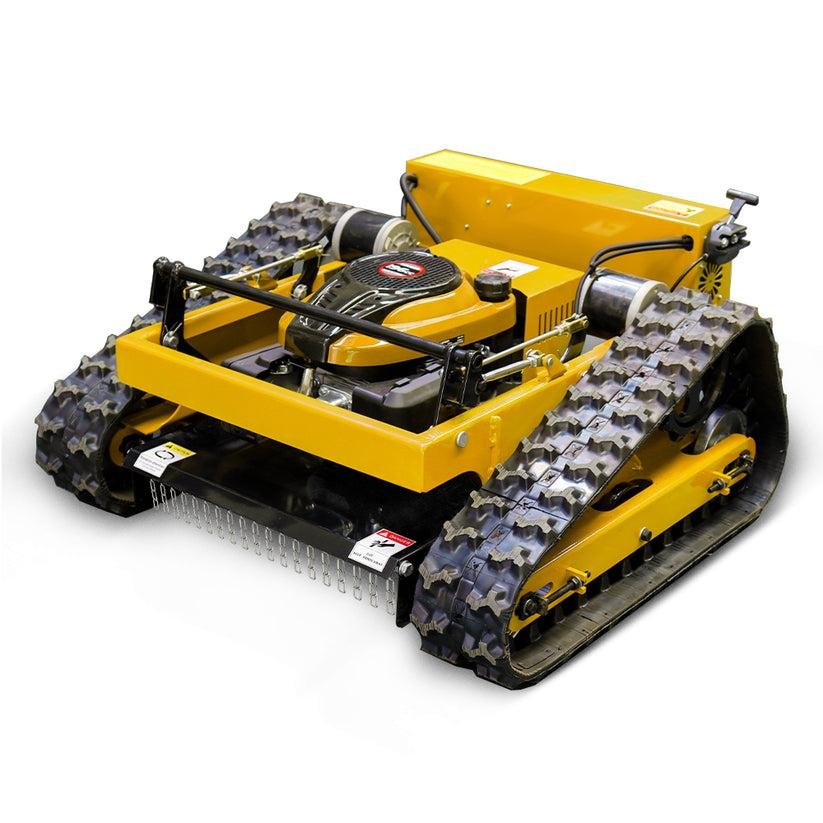
Walk any grounds maintenance yard in early spring and you will see the divide plainly. Some crews wheel out familiar four-wheeled ride-on mowers. Others roll out a squat, low-slung machine on rubber tracks, remote control in hand. The two look like different species, and on flat suburban lawns they broadly do the same work. Take them to a wet embankment, a slope beside a highway, or a steep orchard, and the contrast turns dramatic.
This article compares the two families side by side. It looks at where tracked platforms genuinely outperform wheels, where wheels remain the smart choice, and what a maintenance manager should weigh before shifting a fleet. The goal is not to declare one design universally superior but to map the terrain, workload, and operator considerations that decide which tool earns its place on a given site.
The Fundamental Difference in Ground Contact
The performance gap between the two designs comes down to how each spreads its weight. A wheeled mower concentrates force onto four contact patches, each roughly the size of a hand. A tracked machine spreads the same mass across two long rubber tracks, delivering a contact patch several times larger. That single mechanical fact ripples through every performance category that matters on difficult ground: traction, stability, ground pressure, and turf protection.
On a flat, dry sports field either design works. On a rain-soaked verge, a slope with morning dew, or a bank of long grass hiding uneven ground, the tracked mower simply grips where a wheeled one begins to slide. That grip is not marginal. It converts terrain that used to require hand-held brushcutters and rope harnesses into ground that can be cut safely from a stand-off position with a radio controller.
Slope Performance Where the Gap Widens
The most vivid difference shows up on inclines. A conventional ride-on mower is generally rated for slopes up to fifteen or twenty degrees, and even that number assumes dry conditions, careful pattern selection, and a competent operator. A modern tracked lawn mower designed as a remote-controlled slope cutter routinely handles gradients approaching fifty-five degrees, with some models rated even higher, because the low center of gravity and long track footprint keep the machine planted.
Remove the operator from the machine and you also remove the danger of a rollover crushing a person. Municipal parks teams, highway maintenance contractors, and solar farm operators have adopted tracked mowers largely for this reason. The safety case is straightforward. The productivity case is almost as strong, because slopes that took a two-person hand crew a full day now finish in an hour or two of remote operation.
Turf and Soil Protection Under Load
Ground pressure decides how much damage a machine does when it works over sensitive turf. Wheeled mowers exert roughly two to three times the ground pressure of a tracked unit of equivalent weight, which is why they leave visible ruts on wet sod and compact the soil beneath. That compaction lingers for months, showing up as thin, yellowed grass that recovers slowly and invites weeds.
Tracks on Established Lawns
Tracked mowers can work on wet ground earlier in the day and later after rain than wheels can, because the spread load rides over rather than sinks into the sod. Golf course superintendents, high-end estate maintenance crews, and municipal formal garden teams often extend their cutting windows meaningfully by switching to tracks.
Wheels on Hardscape Transitions
The one category where wheels remain kinder to surfaces is repeated transitions across paved paths and driveways. Tracks scuff hard surfaces slightly under sharp pivots, and long asphalt runs wear rubber faster than a paved-optimized tire compound would. For sites that involve constant crossing between grass and pavement, wheels stay competitive.
Productivity, Cut Quality, and Runtime
Raw cutting speed on flat ground still favors purpose-built wheeled zero-turn mowers, which can reach ground speeds well above what a tracked slope cutter delivers. This matters on large flat parcels like sports complexes and campus lawns, where a fast zero-turn will out-produce a tracked machine by a wide margin. Where the calculation flips is on mixed sites with hills, ditches, and awkward corners. A single tracked mower can safely and quickly handle areas that would otherwise require multiple wheeled machines plus hand crews.
Cut quality depends more on deck design and blade condition than on the platform, but there is a subtle traction advantage. Wheels that begin to slip on slopes drag the deck sideways, creating uneven stripes and scalped patches. Tracks holding a straight line at consistent speed produce a cleaner finish, especially on the tricky transitions between flat and inclined ground.
Total Cost of Ownership Compared Honestly
A tracked slope mower carries a higher purchase price than a comparable wheeled ride-on, and that price is real. Two factors offset it over the life of the machine. First, labor. Replacing a two-person hand-cutting crew for embankments with a single remote operator often pays back the difference within a season on any team that does slope work weekly. Second, insurance. Fleets that shift dangerous slope work off manned machines and onto remotely operated tracked units routinely report reduced claim rates.
Running costs are broadly comparable once you account for tire replacement on wheeled units versus track replacement on tracked ones. Tracks last a long time when kept properly tensioned and free of stones lodged between the sprocket and undercarriage. Neglect either point and life shortens dramatically. Manufacturers such as MMS INDUSTRIAL publish clear track inspection and tension schedules that pay off in extended undercarriage life when crews follow them.
Where Each Design Belongs
The cleanest way to close the comparison is a simple placement rule. Choose wheels for large flat parcels, campus lawns, sports fields, and sites where transitions between grass and pavement dominate the workday. Choose tracks for slopes above about twenty degrees, verges beside highways, dam faces, solar farms, orchards on hillsides, and any turf that stays wet enough to punish wheeled traffic. Mixed fleets are increasingly the norm at larger grounds departments, because each design covers ground the other cannot reach efficiently or safely.
Choosing the Platform That Matches the Ground
The wheeled versus tracked debate is not really a rivalry. It is a mapping exercise. Wheels remain the productive answer on flat, dry, mixed-surface sites where speed and payment-per-hectare drive the business. Tracks are the answer on slopes, soft ground, and any assignment where operator exposure to a rollover risk is unacceptable.
Look at your worst site, not your easiest one. That is the parcel that decides which platform belongs in your yard. Match the machine to the terrain, follow the undercarriage maintenance schedule, and the mower earns its place season after season without theatrics or arguments about which design is best in the abstract.