Most mining equipment failures don’t start with a design flaw. They start at the weld. A bucket wheel arm, a wear liner, a crusher frame: components that passed inspection at delivery and held up fine in the first months of service. Then the hours accumulate, the impact loads compound, and a join that was never quite right becomes a stoppage you’re explaining on a Monday morning. Unplanned downtime in a coal operation costs more per hour than any fabrication decision you’ll make upfront. The weld is where that cost gets locked in.
Understanding the processes, failure modes, and specifications that separate components built to last from components built to look compliant is how you stop being reactive. Knowing what to ask a fabricator before you commit means you’re not finding out what they got wrong six months into a wear cycle. The technical grounding to make a better call starts with what’s actually happening inside the weld.
Why Welding Is a Structural Decision, Not a Trade Decision
A weld determines more than whether two pieces of metal stay joined. It determines how a component absorbs impact, resists abrasion, and survives thermal cycling across thousands of operating hours. In mining equipment, that matters at every join, including bucket teeth, wear liners, conveyor frames, and crusher bodies. These components don’t fail in the middle of the plate. They fail at the weld first.
The distinction that gets overlooked is process selection. A structural weld and a surface weld require different techniques, different filler materials, and different pre- and post-weld controls, and those decisions happen before the first arc is struck, not during. A weld can pass a visual inspection and still carry subsurface porosity, incomplete fusion, or residual stress in the heat-affected zone. Under normal operating loads, it holds. Under mining loads, it doesn’t.
What Welding Failure Actually Costs You
Procurement sees the invoice. Maintenance wears the downtime. That gap is where most welding decisions go wrong. The fabrication quote doesn’t include emergency labour rates, logistics to get a replacement component to a remote site, lost production during an unplanned stoppage, or the hours spent on incident reporting. None of those costs appear on the purchase order, yet all of them follow from it.
The correct metric is cost per operating hour, not unit price. A wear plate at $9,000 that lasts 18 months costs more over five years than a $22,000 plate that runs for eight. The failure modes that drive this, namely delamination at the weld interface, cracking through the heat-affected zone, and premature surface breakdown on hard-faced components, are not random. They are predictable outcomes of the wrong process, the wrong filler, or insufficient pre-weld procedure. The expensive option is not the one with the higher quote.
How Welding Process Selection Affects Component Life
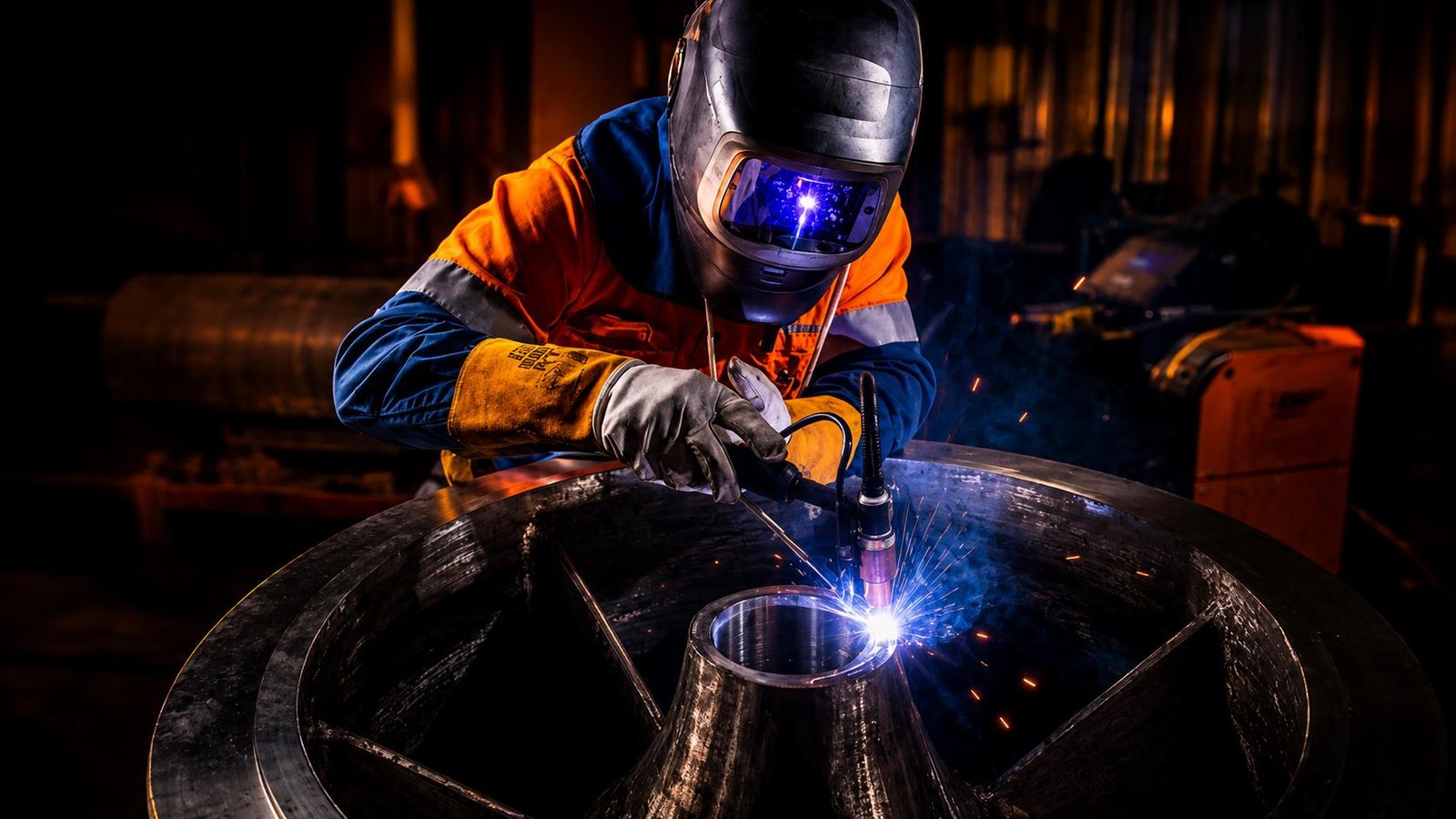
Process selection is as important as welder qualification, and in wear-critical mining applications, the gap between the right process and the wrong one is measured in months of component life. GTAW (TIG) delivers the precision and heat control required for exotic materials and critical structural joins. SAW handles heavy structural fabrication at volume. FCAW suits production environments where deposition rate matters. Each process has a defined application; using the wrong one is not a shortcut, it’s a liability.
For wear plates and high-abrasion surfaces, Plasma Transferred Arc Welding (PTA) sets the benchmark. PTA deposits a hard-facing layer less than 2mm thick, consisting of 60% tungsten carbides in a nickel-silicon-boron matrix, with full metallurgical fusion to the base material. The result extends wear plate service life up to 10 times over conventional product, with a measurable reduction in cost per operating hour and maintenance labour. For the full scope of process capabilities relevant to mining applications, Berg Engineering’s specialised welding services covers the technical detail.
How to Evaluate a Fabricator Before the Job, Not After
A fabricator’s certifications tell you they met a standard at a point in time. They don’t tell you how that standard is maintained across every job, every welder, and every material combination that comes through the door. ISO 3834-2 accreditation covers quality requirements for fusion welding and is the baseline for serious fabrication work. AS 1554 governs structural steel welding to Australian standards. ASME IX covers welder and procedure qualification. A fabricator who holds all three and can produce documentation to support each is a different proposition from one who lists them on a website.
Before committing to any fabrication job on wear-critical components, request the Welding Procedure Specification (WPS) and the Procedure Qualification Record (PQR). The WPS documents exactly how a weld will be made, covering materials, process, and parameters. The PQR proves that procedure was tested and qualified. A fabricator who can’t produce both on request is telling you something. NDT, specifically dye penetrant and magnetic particle testing, should be standard before and after production, not an optional add-on. Pre-repair material verification using XRF analysis confirms material identity before work begins, which matters especially on mixed or unknown alloys. If a quote is low, there’s no WPS on file, and NDT is priced separately, you already know what you’re buying.
Making the Right Call on Welding Starts Before the Quote
Welding quality is a maintenance budget decision. The invoice comes through procurement, but the cost lands in your downtime report, your emergency callout roster, and your next budget review. Predictable component life comes from one place: process discipline, certified procedures, and verified materials applied consistently across every job.