Financial Incentives for High-Quality Home Plumbing and Heating Upgrades
High energy costs and the desire for a more efficient home are common concerns for residents across Massachusetts. We understand the importance of making your home comfortable while also reducing its environmental footprint and your monthly bills. Fortunately, numerous energy rebates are available to make crucial upgrades, like improved plumbing and heating systems, more affordable. This guide will walk you through the process of how to apply for energy rebates in Massachusetts, helping you unlock significant savings and enhance your home’s value.
Massachusetts has consistently been a national leader in energy efficiency, ranking in the top two nationally for over a decade, from 2011 to 2020. This commitment translates into robust programs designed to help residents save money and reduce their carbon footprint. The Mass Save initiative, a collaborative effort by the state’s electric and natural gas utilities, stands at the forefront, having delivered an estimated $3.6 billion in benefits to Massachusetts residents and businesses in 2025 alone. These programs have collectively reduced 76 million metric tons of CO2 lifetime emissions, generating an astounding $31 billion in total benefits for the Commonwealth. Understanding how these programs work is key to transforming your home into a more energy-efficient and comfortable space.
Massachusetts offers a comprehensive suite of financial incentives to encourage homeowners and renters to invest in energy-efficient upgrades. These programs primarily focus on reducing energy consumption, improving home comfort, and supporting the state’s decarbonization goals. The cornerstone of these efforts is Mass Save, which provides a wide array of rebates and services for residential customers.
Mass Save, a collaboration of utilities such as Eversource, National Grid, Cape Light Compact, Liberty Utilities, Berkshire Gas, and Unitil, offers residential programs covering various aspects of home energy efficiency. For those looking to upgrade their heating and cooling systems, heat pumps are a major focus. These highly efficient systems provide both heating and cooling, significantly reducing reliance on fossil fuels. Rebates for heat pump installations can be substantial, with income-eligible households potentially receiving up to $16,000 for partial-home air source heat pump installations and up to $10,000 for whole-home systems. For those installing whole-home ground source heat pumps, rebates can reach up to $25,000. Even for standard whole-home air source heat pumps, Mass Save offers up to $8,500.
Beyond heating and cooling, Mass Save also provides incentives for energy-efficient water heating solutions. High-efficiency water heaters, including heat pump water heaters, can qualify for rebates, helping you save on one of the largest energy consumers in your home. Insulation and air sealing are also critical components of a truly energy-efficient home. Proper insulation and air-sealing measures can lower heating and cooling expenses by approximately 15%, and Mass Save rebates can cover 75% to 100% of insulation installation costs for eligible homeowners, making these foundational improvements highly accessible.
In addition to state and utility-specific programs, federal incentives play a significant role. The federal government offers tax credits under Sections 25C and 25D of the Internal Revenue Code. The 25C tax credit, known as the Energy Efficient Home Improvement Credit, provides a tax credit for certain energy-efficient home improvements, including heat pumps, insulation, and energy-efficient windows. The 25D tax credit, or the Residential Clean Energy Credit, supports investments in renewable energy technologies like solar panels and geothermal heat pumps. These federal tax credits are available through December 31, 2032, offering long-term opportunities for savings.
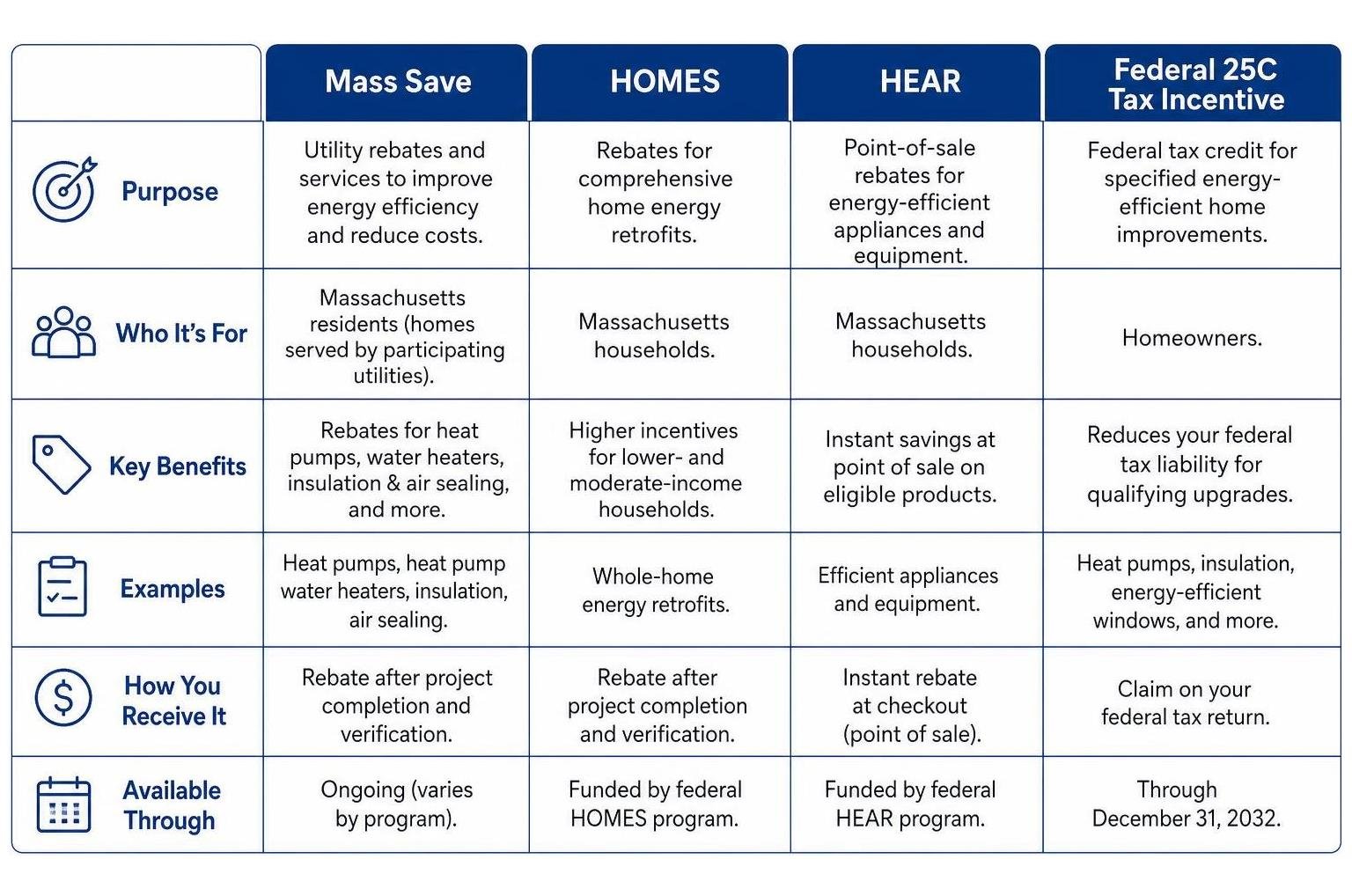
Massachusetts has also received substantial federal funding to further support energy efficiency. The state was allocated $56 million for the federal HOMES Rebate Program and $43 million for the HEAR (Home Energy Rebates) program. The HOMES program provides rebates for comprehensive home energy retrofits, with higher incentives for low-income households (up to $8,000 for those under 80% Area Median Income, and up to $4,000 for moderate-income households between 80-150% AMI). The HEAR program offers point-of-sale rebates for specific energy-efficient appliances and equipment. These federal funds, often administered through MassCEC, can be combined with Mass Save and federal tax credits, allowing homeowners to potentially cover a significant portion, sometimes up to 100%, of their project costs.
Understanding the interplay between these various programs is crucial for maximizing your savings. We’ve outlined a comparison of these key incentives below to help you navigate the options.
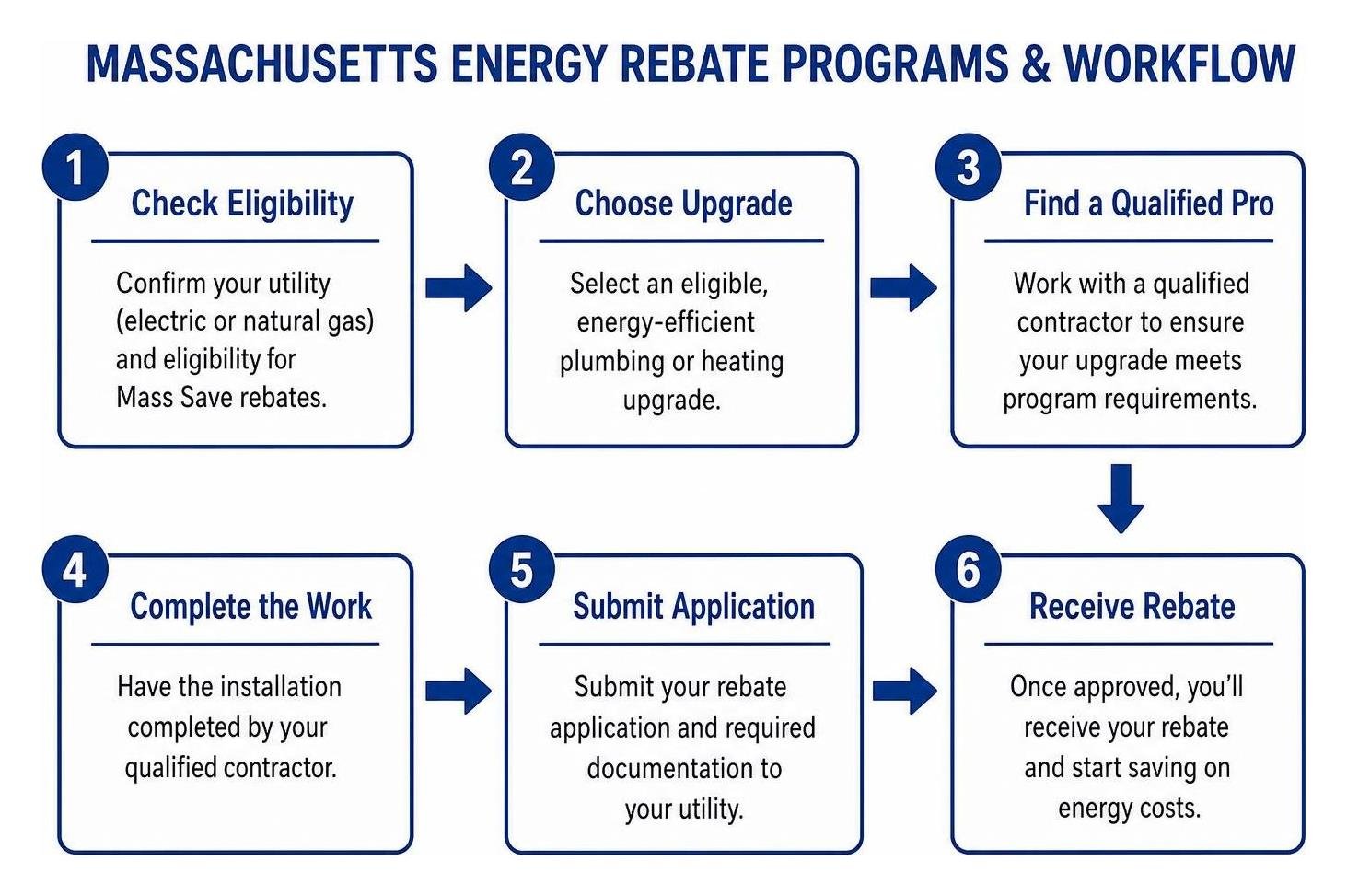
Step-by-Step Process to Apply for Massachusetts Energy Rebates
Navigating the landscape of energy rebates can seem daunting, but with a structured approach, you can effectively apply for and receive the incentives you qualify for. The process typically begins with identifying potential savings and then moves through assessment, application, and verification stages.
The first step for any Massachusetts resident is to explore the available options. A valuable resource for this is the Massachusetts Energy Savings Finder. This free search tool, brought to you by the Massachusetts Community Climate Bank and partners like MassCEC and Mass Save, aggregates local, state, and federal rebates, incentives, and tax credits. By inputting some basic information about your home and your energy goals, the finder can provide a personalized list of programs you might be eligible for.
Another innovative tool, particularly for National Grid customers in specific Massachusetts cities (such as Whitman, Abington, Rockland, Weymouth, Cohasset, Hingham, and Quincy), is MyHEAT maps. This service provides free aerial thermal imaging heat loss maps of homes, allowing you to visualize where your property is losing energy. Identifying these “hot spots” can help prioritize upgrades like insulation and air sealing before you even schedule an assessment. While MyHEAT isn’t directly part of the rebate application process, it offers a powerful diagnostic insight that can inform your decisions.
Once you have an idea of potential upgrades, the most critical initial step for most Mass Save rebates is to schedule a no-cost home energy assessment. This professional evaluation of your home’s energy performance is often a prerequisite for accessing many of the larger rebates.
Scheduling Assessments for High-Quality Home Plumbing and Heating
Booking a home energy assessment through Mass Save is straightforward. You can typically schedule one directly through the Mass Save website or by calling their program administrators. Due to high demand, especially during peak seasons, it’s advisable to book your assessment as soon as possible.
During the assessment, a certified energy specialist will visit your home to conduct a thorough evaluation. This includes:
- Combustion Safety Testing:Ensuring your heating systems and appliances are operating safely.
- Insulation and Air Sealing Checks:Identifying areas where heat is escaping or unwanted air is entering your home.
- Heating and Cooling System Evaluation:Assessing the efficiency of your current furnace, boiler, or air conditioning units.
- Water Heater Analysis:Checking the type and efficiency of your water heating system.
- Lighting and Appliance Review:Offering recommendations for energy-efficient alternatives.
Based on their findings, the energy specialist will provide personalized recommendations for energy-saving upgrades. They can also often perform immediate, no-cost improvements on the spot, such as installing LED light bulbs, smart power strips, and low-flow showerheads. Crucially, the assessment will outline which rebates and financing options, like the 0% interest Mass Save HEAT Loan, are available for the recommended upgrades. This assessment is your roadmap to maximizing energy efficiency and securing rebates for high-quality home plumbing and heating improvements. When considering these upgrades, especially for complex systems like heat pumps or advanced water heaters, consulting with an expert HVAC and plumbing professional can provide invaluable guidance on equipment selection and installation to ensure eligibility and optimal performance.
Documentation Needed for High-Quality Home Plumbing and Mechanical Upgrades
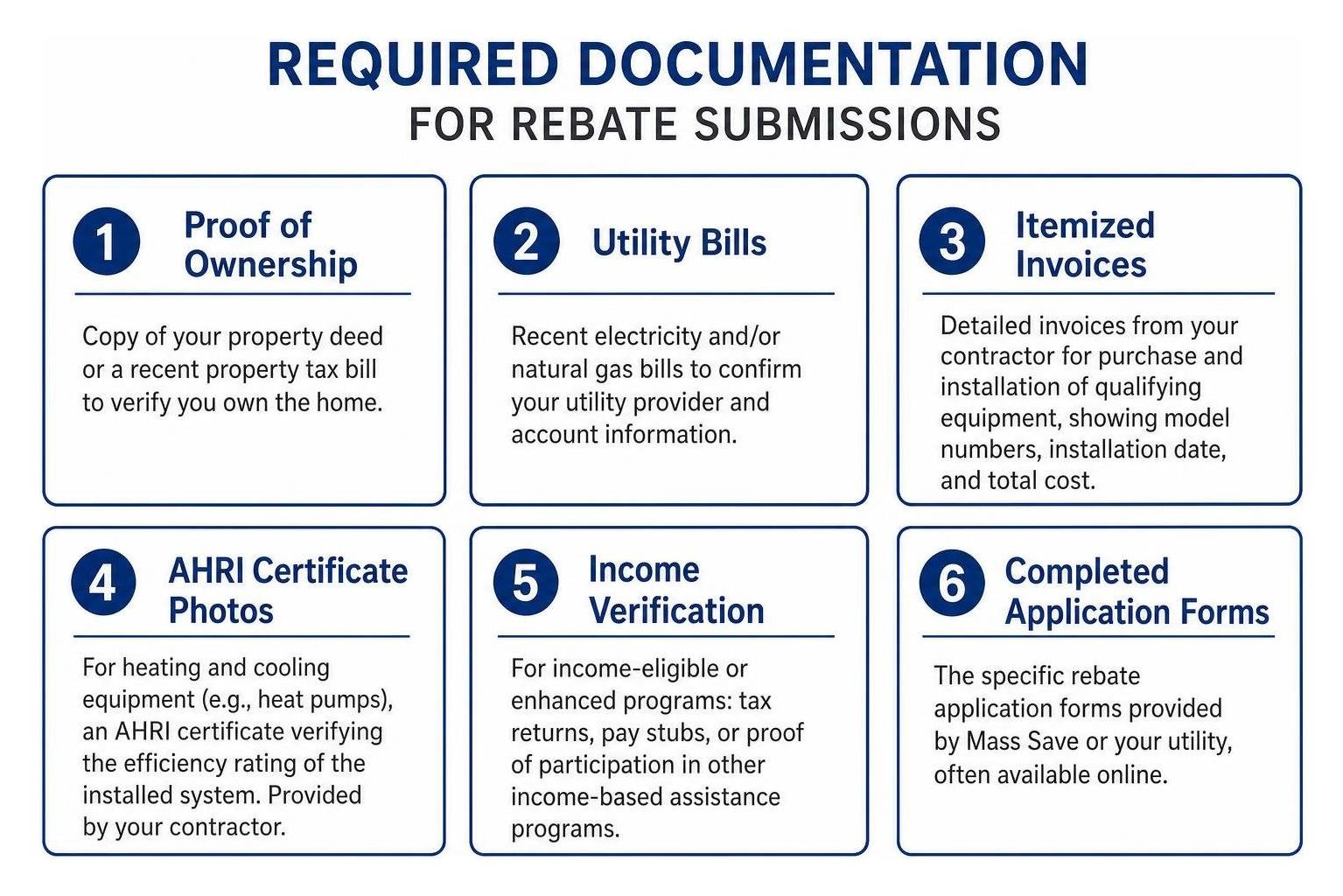
Once you’ve completed your home energy assessment and decided on your upgrades, gathering the necessary documentation is a crucial part of the application process. While specific requirements can vary slightly by program and utility, there’s a common set of documents you’ll generally need to submit.
These typically include:
- Proof of Ownership:A copy of your property deed or a recent property tax bill to verify you own the home.
- Utility Bills:Recent electricity and/or natural gas bills to confirm your utility provider and account information.
- Itemized Invoices:Detailed invoices from your contractor for the purchase and installation of qualifying equipment. These invoices must clearly show the equipment model numbers, installation date, and total cost.
- AHRI Certificate Photos:For heating and cooling equipment like heat pumps, an AHRI (Air-Conditioning, Heating, & Refrigeration Institute) certificate is often required. This document verifies the efficiency rating of the installed system. Your contractor should provide this.
- Income Verification:If you are applying for income-eligible or enhanced rebate programs, you will need to provide documentation such as tax returns, pay stubs, or proof of participation in other income-based assistance programs to verify your household income.
- Completed Application Forms:The specific rebate application forms provided by Mass Save or your utility, often available online.
It’s essential to keep meticulous records of all purchases, installations, and communications related to your energy upgrades. Submitting a complete and accurate application package helps ensure a smoother and faster processing time for your rebate.
Maximizing Savings: Stacking Utility Rebates, Federal Credits, and Income Programs
One of the most powerful strategies for making energy-efficient home improvements affordable in Massachusetts is to “stack” various incentives. This means combining utility rebates, state programs, and federal tax credits to achieve the greatest possible financial benefit. In some cases, particularly for income-qualified households, this stacking can lead to covering a significant portion, or even up to 100%, of the project cost.
Federal tax credits, such as the 25C and 25D credits, are excellent starting points. The 25C credit allows homeowners to claim a tax credit for up to 30% of the cost of eligible energy-efficient home improvements, with annual limits for certain equipment. The 25D credit offers a 30% tax credit for renewable energy installations like solar and geothermal. These credits are applied directly to your tax liability, providing a dollar-for-dollar reduction.
These federal tax credits can often be combined with Mass Save rebates. For example, if you install a qualifying heat pump, you might receive a substantial rebate from Mass Save (funded by your utility like National Grid or Eversource) and then also claim the federal 25C tax credit on your remaining out-of-pocket expenses. The Mass Save program, which includes contributions from utilities like Cape Light Compact, is designed to complement these federal incentives.
Furthermore, the federal HOMES and HEAR programs, administered at the state level, offer additional layers of savings. The HOMES program provides rebates based on the projected energy savings of a comprehensive home retrofit, with higher amounts for lower-income households. The HEAR program offers point-of-sale rebates, making efficient appliances and equipment more affordable upfront. While you generally cannot combine HOMES/HEAR with other federal tax credits for the same measure, you can often combine them with utility rebates. It’s crucial to consult the specific program guidelines to understand the exact stacking rules, as total incentives typically cannot exceed 100% of the project cost.
Income-eligible programs represent another significant opportunity for enhanced savings. Mass Save offers greater discounts and even no-cost options for households that meet specific income criteria, often defined as being below 60% of the Area Median Income (AMI). For these households, insulation upgrades might be entirely free, and enhanced rebates for heat pumps or other major upgrades can dramatically reduce or eliminate out-of-pocket expenses. The federal HOMES program also has tiered incentives based on AMI, providing higher rebates for low and moderate-income households. Always check if your household qualifies for these enhanced incentives, as they can unlock unparalleled savings for your energy efficiency projects.
Frequently Asked Questions about Massachusetts Energy Rebates
Understanding the application process and what to expect is key to a smooth experience. Here, we address some common questions residents have about Massachusetts energy rebates.
How long does it take to get rebate payments approved in Massachusetts?
The timeline for rebate approval and payment in Massachusetts can vary depending on the specific program, the completeness of your application, and the volume of submissions. Generally, after your energy-efficient upgrades are installed and you’ve submitted all required documentation, the processing period can range from several weeks to a few months. For instance, Mass Save often encourages applicants to submit forms promptly, with a typical deadline for equipment purchased in 2025 being February 28, 2026. This suggests that applications are processed throughout the year.
Some programs may offer pre-approval steps, which can help streamline the process by confirming your eligibility before installation. Many utilities and Mass Save also provide online portals or tracking systems where you can monitor the status of your application. While there isn’t a single, universal timeline, being proactive in submitting a complete application and following up if necessary can help ensure a more efficient payment turnaround.
Can renters and income-eligible households qualify for enhanced rebates?
Yes, renters and income-eligible households in Massachusetts can absolutely qualify for energy rebates and often for enhanced incentives. Mass Save, for example, offers specific programs for renters, though landlord approval is typically required for major upgrades like insulation or heating system replacements. Renters can still benefit from no-cost energy-saving products like LED bulbs and smart power strips provided during a home energy assessment.
For income-eligible households, the opportunities are even greater. Mass Save provides significantly enhanced rebates, sometimes even no-cost options or “turnkey services,” for households that meet specific income qualifications, such as being below 60% of the Area Median Income (AMI). These enhanced incentives can cover a larger percentage of project costs for upgrades like insulation, air sealing, and heat pump installations. The federal HOMES program also features tiered rebates, offering higher amounts for low and moderate-income households. We encourage all residents to check their income eligibility, as these programs are designed to ensure equitable access to energy efficiency benefits.
Where can residents find current eligibility rules and rebate deadlines?
The most reliable and up-to-date information on eligibility rules, rebate amounts, and application deadlines can always be found on the official program websites.
- Mass Save:The Mass Save website (com) is the primary resource for residential energy efficiency programs, including home energy assessments, heat pump rebates, insulation incentives, and financing options. They regularly update their site with current offerings and deadlines.
- Massachusetts Department of Energy Resources (DOER):The state’s official gov website, particularly the DOER section on energy programs for individuals, provides an overview of various state-run initiatives and links to other resources.
- Massachusetts Clean Energy Center (MassCEC):For programs related to clean heating and cooling, including specific heat pump incentives and information on federal HOMES and HEAR rebates, the MassCEC website (com) is an essential resource.
Always cross-reference information from these official sources, as program details and deadlines can change. It’s also a good practice to contact your specific utility provider (e.g., National Grid, Eversource) directly, as they may have additional, localized programs or specific application requirements.
Conclusion
Investing in high-quality home plumbing and heating systems is not just about enhancing comfort; it’s about making a smart financial decision and contributing to a sustainable future. Massachusetts offers an impressive array of energy rebates and incentives designed to make these crucial upgrades more accessible and affordable. By leveraging programs like Mass Save, federal tax credits, and specialized income-eligible initiatives, you can significantly reduce your upfront costs and enjoy long-term savings on your energy bills.
The journey begins with exploring your options through tools like the Massachusetts Energy Savings Finder and scheduling a no-cost home energy assessment. From there, understanding the documentation requirements and strategically stacking available incentives will pave the way for a successful application. As we look towards August 2026 and beyond, the commitment to energy conservation and decarbonization in Massachusetts remains strong, offering continuous opportunities for homeowners and renters to improve their living spaces. Embracing these programs means a more comfortable home, lower utility expenses, and a positive impact on the environment, ensuring a sustainable and efficient future for all.