Key Takeaways
- A claim may include medical costs, lost income, property damage, pain and suffering, and other legally available losses.
- Serious injuries, long-term limitations, and documented financial losses can increase the potential value of a case.
- Fault matters greatly in Alabama, so evidence from the crash scene and the trucking company may be important.
- Commercial truck cases may involve several potentially responsible parties, not just the driver.
- Quick settlement offers may not account for future treatment, lost earning ability, or the full impact of an injury.
- Deadlines can apply, so it is important to seek case-specific guidance without unnecessary delay.
A truck accident claim in Alabama does not have a standard price tag. Its value depends on the injuries, the available evidence, the parties involved, insurance coverage, and how clearly fault can be shown. After a collision involving an 18-wheeler, delivery vehicle, or other commercial truck, speaking with Roger Varner Law may help an injured person understand the facts that could affect a claim in Mobile or elsewhere in Alabama.
Truck crashes can have consequences that extend far beyond the scene, whether the wreck occurs near the Port of Mobile, on I-10, along the I-65 corridor, or on a rural Alabama highway. Medical needs, missed work, vehicle damage, and uncertainty about the future can all shape the potential value of a claim. Every case must be evaluated on its own evidence rather than compared to a headline settlement or a number found online.
Table Of Contents
- Why There Is No Average Truck Accident Settlement
- Losses That May Affect Claim Value
- How Injury Severity Changes a Claim
- Why Fault Is Especially Important in Alabama
- Potentially Responsible Parties
- Evidence That Can Strengthen a Claim
- Insurance and Settlement Considerations
- Timing, Deadlines, and Next Steps
Why There Is No Average Truck Accident Settlement
There is no reliable “average” amount that can predict what a particular Alabama truck accident claim is worth. Two crashes may look similar at first, yet one person may recover after a few weeks while another requires surgery, rehabilitation, home assistance, or permanent work restrictions. The details of liability, medical proof, insurance limits, and the credibility of the evidence can lead to very different outcomes.
Property damage alone also does not establish the value of an injury claim. A forceful impact may cause visible damage, but medical records, physician opinions, treatment history, and the practical effect on daily life are usually more meaningful when evaluating bodily injury losses.
Losses That May Affect Claim Value
A truck accident claim may seek compensation for losses connected to the collision. The appropriate categories depend on the facts, the evidence, and applicable Alabama law.
Economic losses
- Emergency transportation, hospital treatment, physician visits, medication, therapy, and rehabilitation costs.
- Reasonable future medical needs when supported by medical evidence.
- Lost wages, reduced hours, and lost earning capacity when an injury affects work.
- Vehicle repair or replacement costs, towing charges, rental expenses, and damaged personal property.
- Out-of-pocket expenses, such as travel for medical treatment or necessary help at home.
Non-economic losses
Physical pain, emotional distress, loss of normal activities, scarring, and lasting limitations may also be considered. These losses do not come with receipts, which is why consistent medical care and a clear record of how injuries affect everyday life can matter.
How Injury Severity Changes a Claim
Generally, a claim involving a documented traumatic brain injury, spinal injury, broken bones, serious burns, internal injuries, or a condition requiring extensive treatment may involve greater losses than a claim involving short-term soreness. That does not mean every injury with the same diagnosis has the same value. Age, occupation, recovery outlook, prior health, treatment needs, and the ability to return to ordinary activities all deserve individual consideration.
It is wise not to minimize symptoms after a truck collision. Some conditions become clearer over time, and a person should follow medical instructions and attend recommended follow-up appointments. Medical decisions should be made by qualified health professionals, not under pressure from an insurer or due to concerns about the claim.
Why Fault Is Especially Important in Alabama
Determining fault can be central to the value of an Alabama truck accident case. The driver, trucking company, or another party may dispute how the crash occurred, especially in lane-change, rear-end, intersection, weather, or multi-vehicle collisions. Alabama follows contributory-negligence principles in ordinary negligence cases, so an allegation that an injured person contributed to the crash can have serious consequences. That makes prompt preservation of evidence particularly important.
Official reports can be useful, but they are only part of the overall picture. Photos, vehicle damage, witness accounts, road conditions, medical records, and electronic data may all help clarify what occurred.
Potentially Responsible Parties
A commercial truck crash may involve more parties than a typical passenger-car collision. Depending on the circumstances, a claim may involve the truck driver, motor carrier, owner of the tractor or trailer, cargo-loading company, maintenance provider, broker, or a manufacturer. Identifying every potentially responsible party can affect available insurance coverage and the evidence that must be preserved.
For example, records concerning hours of service, inspections, maintenance, dispatching, cargo securement, and driver qualifications may be relevant in some cases. Federal rules require many commercial drivers to use electronic logging devices, and these requirements for commercial carriers help explain why driving-time records can matter after a serious crash.
Evidence That Can Strengthen a Claim
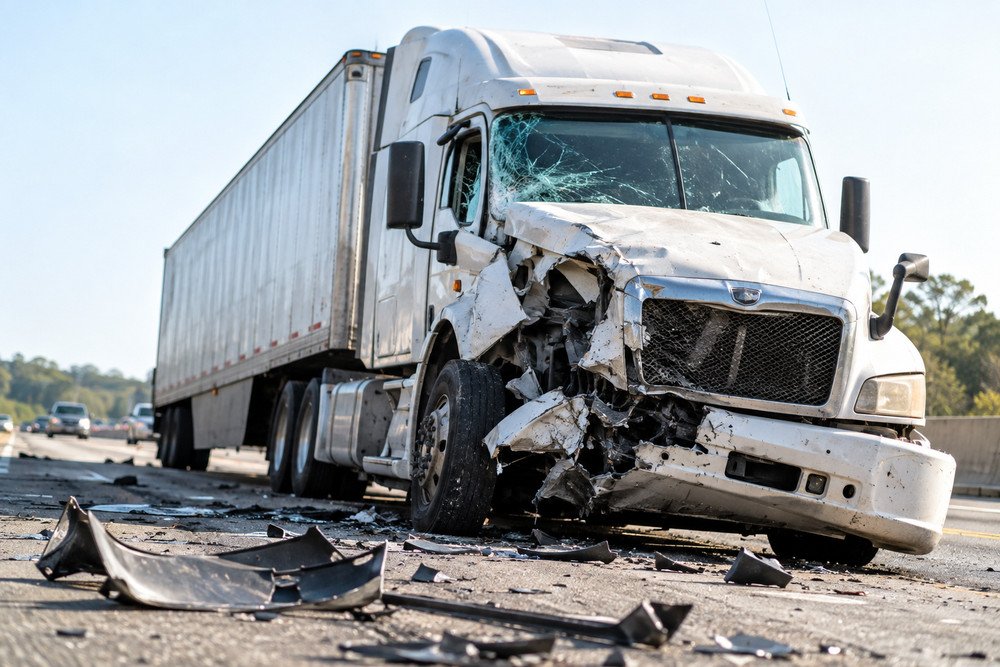
Evidence can disappear quickly after a commercial vehicle collision. If safety permits, photographs of vehicles, skid marks, debris, lane markings, traffic signals, weather conditions, and visible injuries may be useful. Keep original files rather than editing or filtering them.
- Request and save the crash report when it becomes available.
- Collect names and contact information for witnesses.
- Preserve medical bills, treatment records, work absences, and repair estimates.
- Keep insurer letters, emails, text messages, and claim numbers in one folder.
- Do not discard damaged personal property before it has been documented.
Insurance and Settlement Considerations
Insurance coverage can influence settlement discussions, but policy limits do not automatically determine a claim’s value. A carrier may investigate the crash, request records, or ask for a recorded statement soon after the incident. Provide truthful basic information, but avoid guessing about speed, distance, fault, the full extent of injuries, or future recovery.
Before accepting a settlement, consider whether the amount addresses current bills, future medical care, lost income, vehicle losses, and the possibility that symptoms may continue. A signed release can end the right to pursue additional payment from the released parties, which is why careful review is important.
Timing, Deadlines, and Next Steps
Alabama law generally provides a two-year limitations period for many injury claims, although the correct deadline can depend on the type of claim and the facts involved. The Alabama limitations statute includes two-year limitations periods for actions involving personal injury and certain claims arising from an employee’s conduct. Waiting can make it harder to locate witnesses and preserve trucking records.
The most useful next step is to prioritize medical care, keep organized records, and obtain advice tailored to the collision. A careful review of the evidence, injuries, insurance information, and possible responsible parties offers a far more meaningful estimate than any generic truck accident settlement number.