Key Takeaways
- Utilize supplementary cementitious materials to reduce carbon emissions.
- Incorporate recycled aggregates to minimize environmental impact.
- Implement water-reducing technologies to conserve resources.
- Adopt efficient curing practices to enhance durability.
- Consider fiber reinforcement to improve structural integrity.
Concrete is integral to modern infrastructure—from city skyscrapers to home patios—thanks to its unmatched strength and versatility. However, not all concrete is created equal when it comes to longevity and environmental impact. If you have questions about concrete, understanding the newest advances and best practices can help make your projects more durable while also reducing their carbon footprint. Implementing more innovative strategies and materials will not only extend the lifespan of concrete structures but also improve their performance. Still, it will also strengthen your commitment to sustainability, which is increasingly essential in today’s built environment.
Reducing waste, maximizing recycled content, and optimizing resource conservation are all pivotal to the responsible use of concrete. Beyond environmental benefits, innovative concrete approaches also help achieve superior structural performance, minimize repair costs, and promote resilience against environmental stressors.
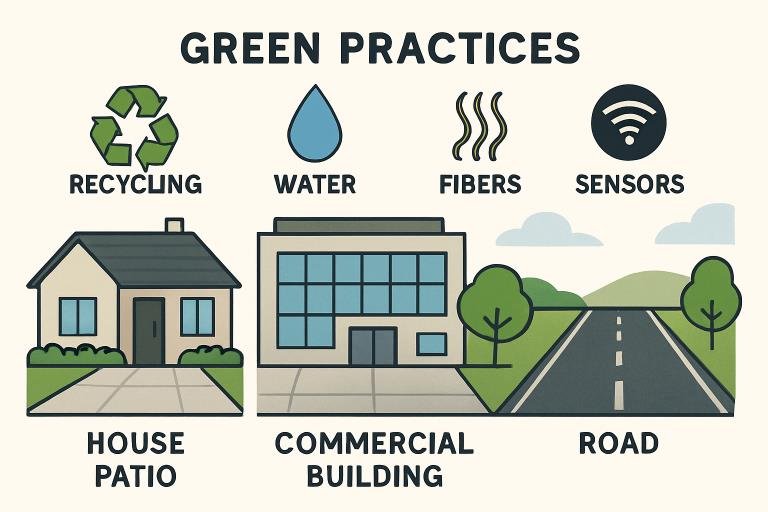
From residential patios to commercial buildings and municipal infrastructure, every concrete project offers opportunities for upgrading sustainability and durability. Choosing the right aggregates, carefully managing water usage, and embracing new technologies allow builders and DIYers alike to enhance concrete performance and environmental responsibility.
Crucially, project timelines and material needs can be affected by weather conditions. For those building in cold weather, understanding the impact of temperature on concrete curing and strength is equally important for ensuring a successful outcome.
Utilize Supplementary Cementitious Materials
Integrating supplementary cementitious materials (SCMs) such as fly ash, slag, and silica fume into your mix is an effective way to reduce greenhouse gas emissions. These industrial byproducts substitute a portion of traditional cement, reducing the overall carbon footprint. According to Scientific American, cement production accounts for a large share of global CO₂ emissions, so replacing even a small portion of it with SCMs can make a significant environmental difference. Besides sustainability, SCMs can also boost concrete’s strength and durability, making them a win-win for every project.
Incorporate Recycled Aggregates
Recycled aggregates—sourced from crushed concrete, reclaimed asphalt, or other construction debris—diminish the reliance on virgin materials while minimizing landfill waste. Numerous tests cited by Architectural Digest show that recycled aggregates not only perform comparably to their natural counterparts but also often yield concrete with enhanced compressive strength and durability. This approach makes recycling in concrete projects both environmentally and structurally sound.
Implement Water-Reducing Technologies
Water is a necessary ingredient in concrete, yet excessive amounts undermine both ecological goals and final strength. The use of advanced water-reducing admixtures—chemical compounds that reduce the water required for mixing while maintaining workability—allows for efficient hydration and denser, more durable concrete. These admixtures help conserve water resources, and the resulting concrete is often more resistant to permeability and cracking.
Adopt Efficient Curing Practices
Proper curing is essential for unlocking concrete’s full strength and durability potential. Traditional curing methods rely on continuous wetting, which can be water-intensive and time-consuming. Modern alternatives, such as curing compounds or membrane-forming coatings, enable moisture retention without excessive water use. Efficient curing not only shortens project timelines but also ensures consistent hydration, strengthening concrete against weathering and structural stress.
Consider Fiber Reinforcement
Fiber-reinforced concrete incorporates synthetic, steel, or glass fibers within the mix, dramatically increasing crack resistance and impact toughness. Fibers control micro-cracking and distribute stresses more evenly, enhancing both the lifespan and resilience of finished structures. This solution is increasingly favored not just for industrial floors and roadways, but also for residential and municipal applications seeking added durability with minimal additional cost.
Explore Self-Healing Concrete
Self-healing concrete represents a breakthrough in sustainable construction, leveraging embedded capsules or bacteria that release healing agents when cracks form. These innovative mixtures autonomously repair minor damage before it propagates into larger structural issues, drastically reducing the frequency and expense of repairs. Self-healing technology extends the functional life of concrete structures, minimizing material and energy use across their lifecycle.
Opt for Low-Carbon Cement Alternatives
Traditional Portland cement production is energy-intensive and emits large amounts of CO₂. Alternatives such as Limestone Calcined Clay Cement (LC³) and geopolymer cements offer lower carbon profiles by utilizing abundant, naturally occurring materials. These next-generation cements reduce energy inputs during manufacturing and provide a similar—if not improved—level of performance for concrete applications, making them cornerstones in green construction efforts.
Integrate Smart Sensors for Monitoring
Modern smart sensors can be embedded directly into concrete during pouring. These sensors track real-time data on moisture, temperature, and structural changes, enabling precise adjustments to curing and maintenance practices. Real-time monitoring ensures optimal strength development and significantly reduces material waste by indicating exactly when a slab is ready for subsequent construction phases. As highlighted in Forbes, IoT-enabled sensors are transforming construction processes, making them more efficient and reliable.
By embracing these advanced techniques and materials, contractors, architects, and homeowners can ensure their concrete projects are both long-lasting and ecologically responsible. As innovation continues to permeate the construction industry, prioritizing sustainability and durability will not only future-proof your structures but also drive meaningful environmental benefits on a broader scale.