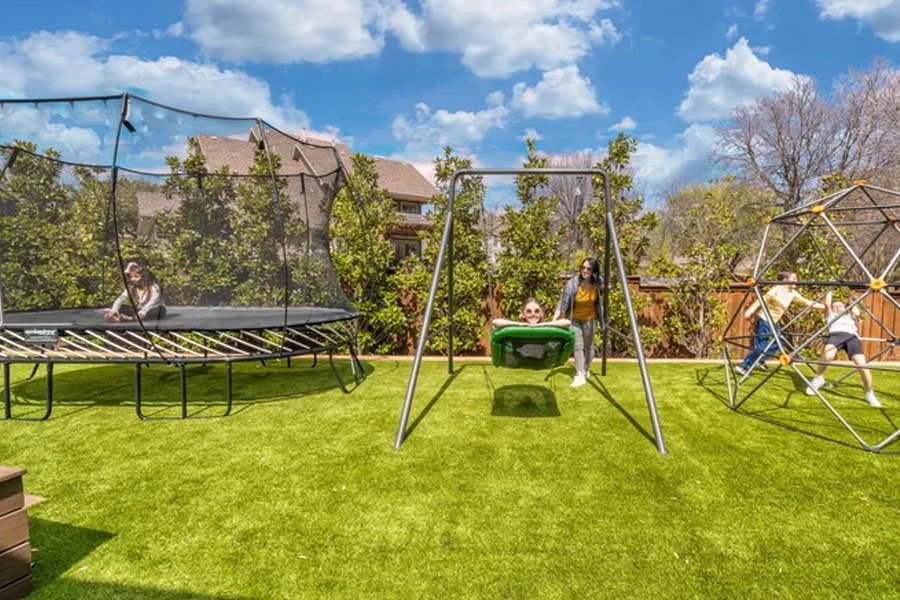
A trampoline and a basketball hoop are two of the most requested backyard additions for families with kids, and for good reason: together they cover active play, structured games, and free-form fun in a single corner of the yard. But getting the layout right matters more than people expect. A poorly planned setup creates safety hazards, wastes usable space, and often ends up half-used because the placement makes it inconvenient rather than inviting. Here’s how to actually plan a backyard play zone that works.
Start With Clearance, Not Aesthetics
The instinct with any new yard feature is to think about how it looks first. With play equipment, safety clearance should come first instead. A trampoline needs open space on all sides, not just the footprint of the frame itself. Most manufacturers recommend at least several feet of clear space around the entire perimeter, free of fences, trees, patio furniture, and structures, since kids being jumped or bounced toward the edge need somewhere safe to land if they go past the enclosure netting.
The same logic applies above the trampoline. Overhanging tree branches, power lines, or a covered patio roof positioned too close can turn a fun bounce into a collision hazard. Before committing to a spot, stand where the trampoline would go and look straight up. If anything is within reach of a jumper’s highest bounce, that’s not the right location.
A basketball hoop attached to the trampoline enclosure inherits the same clearance needs, plus one more consideration: ball retrieval space. Kids chasing a missed shot need room to move without stepping into a neighboring garden bed, a pool area, or the street. If your yard is tight, think about which direction missed shots are most likely to travel, usually away from the hoop’s mounting side, and make sure that path is clear of anything fragile or dangerous.
Match the Setup to Your Yard’s Actual Shape
Not every yard can accommodate a large square trampoline with a hoop attachment and still leave room for anything else. This is where shape and size choice matters as much as placement.
Narrow, rectangular yards tend to work better with an oval trampoline oriented along the yard’s longer axis, since a square or round trampoline in a narrow space eats into clearance on both sides. An oval shape also often accommodates a hoop attachment more naturally on one of its shorter ends.
Wider, more square yards have more flexibility, and can typically support a larger square trampoline without sacrificing clearance, plus additional space nearby for other activities.
Sloped yards need extra planning. A trampoline needs a level base to sit and bounce safely, so a sloped area either needs grading work before installation or should be ruled out in favor of the flattest available section of yard, even if that means a smaller footprint than you originally wanted.
Think About Sightlines, Not Just Space
One detail that’s easy to overlook: where you’ll actually be standing or sitting when supervising. A trampoline and hoop combo tucked into a far corner behind a shed or dense landscaping might technically fit, but if it’s out of view from the kitchen window, the patio, or wherever adults naturally spend time outside, supervision becomes harder and less likely to happen consistently. Positioning the play zone somewhere visible from inside the house, or from a patio seating area, makes casual supervision effortless instead of requiring a deliberate walk to check in.
Surface Matters More Than People Expect
Grass is the default surface under most backyard trampolines, and it works fine in many cases, but it’s worth thinking through a few surface-specific issues. Grass under a trampoline tends to wear down and die from lack of sunlight and constant use, often leaving a bare, muddy patch within a season or two. Some families address this with a rubber mulch base, artificial turf, or a dedicated gravel pad beneath the trampoline’s footprint, which also helps with drainage after rain and reduces mud getting tracked back into the house.
For the basketball portion specifically, if kids are dribbling as well as shooting, a hard, level surface nearby (even a small paved or packed section) makes for a much better bounce than grass, which absorbs the ball’s energy and makes dribbling nearly impossible.
Leave Room to Grow Into the Space
A common mistake is designing the play zone entirely around a young child’s current size and interests. Kids grow, and so does what they want from a backyard. Leaving a bit of extra buffer space around the trampoline and hoop setup, even if it’s not strictly needed on day one, gives room for a cornhole set, a small seating area, or simply more active space as kids get older, more coordinated, and start inviting more friends over.
The Bottom Line
The best backyard play zone isn’t necessarily the biggest or the most elaborate. It’s the one placed with enough clearance to be genuinely safe, oriented to fit the yard’s actual shape rather than fighting it, visible enough that supervision happens naturally, and built on a surface that holds up to daily use. Get those fundamentals right, and the trampoline and hoop combination tends to become the most-used part of the yard, exactly what it’s meant to be.