Key Takeaways
- Build implant treatment around a connected workflow from diagnosis through maintenance.
- Start with complete medical, dental, periodontal, occlusal, and restorative assessments.
- Plan implant placement around the final restoration rather than bone availability alone.
- Use CBCT, scans, guides, and digital tools alongside clinical judgment.
- Coordinate responsibilities among the dentist, surgeon, laboratory, and dental team.
- Prepare for surgical risks, unexpected findings, and alternative treatment plans.
- Match case complexity to the clinician’s training and experience.
- Track healing, biological and mechanical complications, and patient concerns during follow-up.
- Use case reviews and continuing education to improve future treatment planning.
Predictable implant care is not created by a single scan, guide, implant system, or surgical technique. It comes from a connected process that carries the same restorative goal from the first consultation through maintenance. Educational resources, such as Simply Implants Institute, can support professional development, but dependable outcomes ultimately depend on careful case selection, sound clinical judgment, and consistent execution. A practical workflow helps the dentist identify risks early, coordinate the surgical and restorative phases, and communicate more clearly with patients and the dental team. It also creates a repeatable framework while leaving room for clinical adjustments when anatomy, healing, or patient needs require a different approach.
Why Workflow Matters in Implant Dentistry
Implant treatment involves a chain of decisions. Incomplete records, an uncertain bite relationship, unclear restorative goals, or missing follow-up plans can affect later stages of care. A task-based process treats diagnosis, surgery, and restoration as separate events. A workflow connects them before treatment begins. Technology may improve planning and communication, but it does not replace the clinician’s responsibility to assess the patient, verify records, and adapt when needed.
Start With a Complete Diagnosis
Before approving a plan, evaluate the medical and dental history, periodontal condition, oral hygiene, occlusion, parafunctional habits, adjacent teeth, existing restorations, bone and soft tissue, and the patient’s expectations. A CBCT scan should answer a defined clinical question, such as the location of vital structures, sinus anatomy, root position, bone contours, or restorative space. Imaging is most valuable when it is interpreted alongside the clinical examination and restorative plan.
Plan From the Final Restoration
Restorative-driven planning begins with the intended crown, bridge, overdenture, or full-arch prosthesis. Consider tooth position, appearance, phonetics, cleanliness, emergence profile, screw-access location, tissue support, and occlusal loading before finalizing implant position. A diagnostic wax-up or digital design can clarify the intended result. Placing an implant only where bone appears most available may lead to an off-center crown, limited access for hygiene, or an unfavorable smile line.
Use Digital Tools With Clinical Judgment
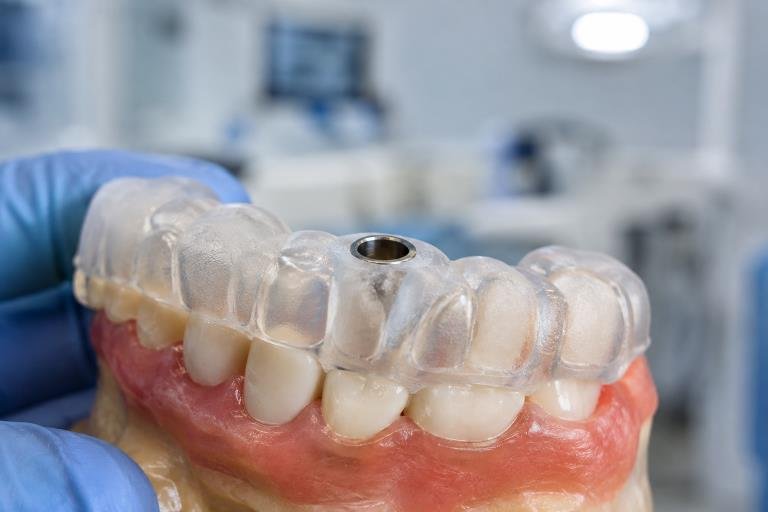
Intraoral scans, CBCT data, planning software, surgical guides, and printed models can make records easier to share and review. Check scan quality, bite registration, soft-tissue information, and the alignment of merged files before relying on a virtual plan. Review the case in several views, then compare it with the patient’s actual anatomy. A study of standardized digital implant training found potential benefits for simulated preclinical learning, while also noting the need for further long-term research. Every guided case needs a backup plan. The team should know what to do if a guide does not seat fully, visibility is limited, or bone quality differs from expectations.
Build a Strong Team System
Predictable care depends on coordination among the restorative dentist, surgeon or specialist, laboratory, assistants, hygienists, and patient. Assign responsibility for records, planning, component ordering, provisionalization, and follow-up. Use one approved plan and document changes promptly. For complex treatment, laboratory input before surgery can prevent avoidable compromises. The digital planning principles for terminal dentition cases, as emphasized by the American College of Prosthodontists, illustrate the value of integrating facial, occlusal, and restorative information early.
Prepare for Surgery and Manage Risk
Preparation reduces preventable surprises. Before the appointment, confirm the health history and medications, approved treatment plan, consent, implant sizes, guide, instruments, components, backup supplies, and post-operative instructions. When immediate provisionalization is planned, verify that the provisional restoration and delivery protocol are ready. A written risk review is especially useful for complex cases. Discuss active periodontal disease, nicotine use, uncontrolled systemic conditions, limited bone or soft tissue, inadequate restorative space, heavy bite forces, poor plaque control, and unrealistic expectations. Some risks can be addressed before treatment. Others may require referral, modified treatment, or postponement.
Turn Training Into Repeatable Clinical Skill
Watching procedures is not the same as developing reliable clinical ability. Start with cases that match current training and experience. Practice diagnosis and planning before surgery; use models or simulations to build hand skills; seek feedback on surgical and restorative decisions; and review completed cases honestly. A useful learning cycle is simple: plan, perform, review, adjust, and repeat. Progression to more demanding cases should be based on consistent performance, not just familiarity with a technique.
Track Results After Treatment
Follow-up is part of treatment, not an administrative afterthought. Record healing observations, implant stability when assessed, soft-tissue condition, occlusion, prosthetic components, hygiene access, radiographic findings when appropriate, and patient concerns. Track issues such as guide seating problems, remakes, biological complications, mechanical complications, and unexpected referrals. Reviewing these patterns can improve future planning and team communication.
Common Questions About Implant Workflows
Does every implant case need a fully digital workflow?
No. The appropriate workflow depends on the case, available records, restorative demands, and the clinician’s ability to use each tool accurately.
Can a surgical guide guarantee accuracy?
No. A guide can help transfer a plan, but its usefulness depends on accurate records, stable seating, correct instruments, patient anatomy, visibility, and careful execution.
When should a dentist refer a case?
Referral may be appropriate when anatomy, medical factors, bone loss, reconstruction needs, or restorative complexity exceed the clinician’s training and experience.
A Better Workflow Starts With Better Decisions
Safer, more predictable implant treatment is built through connected planning rather than relying on a single product or technique. Complete diagnosis, restorative thinking, preparation, teamwork, appropriate technology, continuing education, and structured follow-up all strengthen the process. The most useful advances in 2026 are the ones that help clinicians make clearer decisions and deliver care that can be repeated responsibly.
Conclusion
Predictable implant treatment depends on a consistent process rather than any single technology, implant system, or surgical technique. Complete diagnosis, restorative-driven planning, appropriate digital tools, careful preparation, and effective communication can help the dental team manage each stage more systematically. Clinicians should also recognize the limits of their training, prepare for unexpected findings, and refer complex cases when appropriate. Follow-up is equally important because healing, hygiene, occlusion, prosthetic performance, and patient concerns can provide useful information for ongoing care and future case planning. Continuing education and structured case review can further help clinicians strengthen their skills and identify areas for improvement. By connecting diagnosis, treatment planning, surgery, restoration, maintenance, and professional development, dental teams can create a workflow that supports careful clinical decisions while remaining adaptable to each patient’s anatomy, health, and treatment needs.