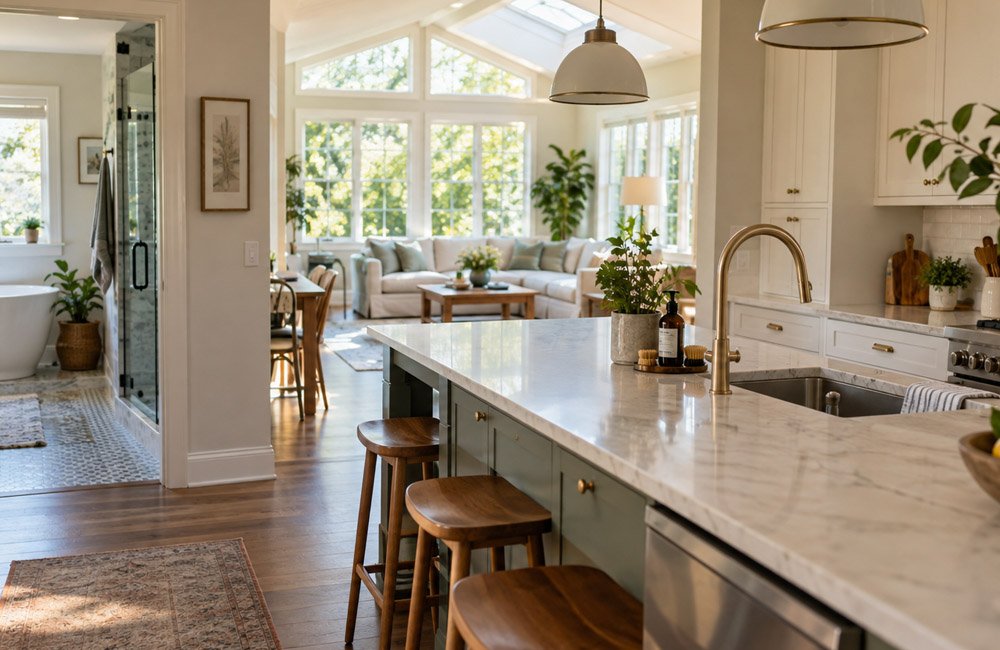
Ask three homeowners which renovation is worth the money and you’ll get three different answers. Ask three real estate agents and you’ll probably get three more. The kitchen people swear by the kitchen. The bathroom crowd insists a spa-like bath wins buyers over. And then there’s the addition camp, who believe the only renovation that truly pays is the one that adds square footage.
The honest answer is that all three can add value, but they do it in very different ways, and the “best” choice depends on your house, your neighborhood, and how long you plan to stay. What I want to do here is break down how home renovations in each of these three categories actually affect value, based on what the data tends to show and what experience bears out, so you can make a smarter decision for your own property.
First, a Quick Lesson in How Renovation Value Actually Works
Before comparing the three projects, it helps to understand one core principle. Renovations rarely return dollar-for-dollar at resale. Industry cost versus value reports say the same thing year after year: most projects recoup somewhere between 50 and 80 percent of their cost in added home value. That sounds discouraging until you realize the numbers don’t tell the whole story.
Value from a renovation comes in two forms. There’s the resale value, which is what a buyer will pay extra for, and there’s the use value, which is what you get out of the project while you still live in the home. A renovation that returns 70 percent on paper might return far more in practice if it lets you enjoy your home for five more years without wanting to move.
There’s also a ceiling to be aware of. Your home’s value is anchored to your neighborhood. Renovate past what comparable houses sell for and you won’t get the money back no matter how nice the work is. Keep that in mind as we go through each option.
The Kitchen: The Highest Stakes, The Highest Reward
The kitchen is the room buyers judge the whole house by. That’s why it’s been the default answer to the value question for decades, and it’s still mostly true.
A well-executed kitchen renovation tends to recoup a solid share of its cost, often in the 50 to 70 percent range for a midrange remodel, and it does something no other project does as well: it speeds up the sale. A dated kitchen makes buyers mentally deduct the cost and hassle of renovating it themselves, and many will simply move on to the next listing. A finished kitchen removes that objection entirely.
But the kitchen carries the most risk of the three. It’s usually the most expensive project on the list, it takes the longest, and it’s the easiest to overspend on. High-end appliances and custom cabinetry rarely return their cost. The value comes from a layout that works, adequate storage, good lighting, and durable finishes, not from luxury labels.
The kitchen is the right call if your kitchen is noticeably dated compared to your neighborhood, or if you plan to stay long enough to enjoy it. It’s the wrong call if you’re renovating purely to flip, or if your kitchen is already functional and the rest of the house isn’t.
The Bathroom: The Smaller Investment With a Reliable Return
Bathrooms cost less than kitchens, which changes the math in an interesting way. A midrange bathroom remodel is one of the most consistent performers in cost versus value studies, often recouping a similar or even higher percentage than a kitchen, simply because the starting investment is smaller and the work is less complex.
The bathroom’s strength is reliability. It’s a smaller project, so there’s less that can go wrong, fewer decisions to agonize over, and a shorter construction window. And functionally, bathrooms matter enormously to buyers. An outdated or missing bathroom is a dealbreaker in a way that an outdated laundry room never is.
Where bathrooms shine is in fixing genuine problems. If your home has one bathroom and every comparable house has two, adding one is close to a no-brainer. If your only bathroom is a dark, cramped space from the 1970s, modernizing it removes a major objection from every buyer’s mind.
The bathroom is the right call when the existing bathrooms are genuinely behind the times, when you need to add one to keep pace with your market, or when you want a meaningful improvement without a kitchen-sized budget. It’s the wrong call if the bathroom is already fine and you’re chasing value alone, because a tasteful, functional bathroom is hard to improve enough to justify the cost.
The Addition: The Biggest Swing, The Most Complicated Math
An addition is the only project of the three that adds actual square footage, which means it’s the only one that can move your home into a different category. A three-bedroom house that becomes a four-bedroom house, or a home that gains a proper primary suite, can jump in value in a way no interior remodel can match.
But additions are also the most expensive, the most disruptive, and the most dependent on getting the local market right. You’re dealing with foundations, roofing, permits, and sometimes zoning limits. The cost per square foot is typically higher than interior work, and the return varies wildly by region and neighborhood.
The addition is the right call when your home is smaller than what buyers in your area expect and the lot supports it, or when the addition solves a structural problem, like a family that needs another bedroom or a home that has no functional living space on the main floor. It’s the wrong call when cheaper houses nearby cap what your expanded home can sell for. Building the biggest house on the block is a classic way to lose money.
So Which One Wins?
Here’s the answer nobody wants to hear: it depends, but it depends in predictable ways.
If your kitchen is the weak point of your house, fix the kitchen. It has the most influence on buyer perception and sale speed.
If your kitchen is fine but your bathrooms aren’t, do the bathrooms. You’ll spend less, finish faster, and still remove a major buyer objection.
If your house is simply too small for its market, the addition is the only project that changes that, but only if the neighborhood can support the higher price.
And if you’re staying long term, weight the decision toward whichever project improves your daily life the most. The resale percentage is a snapshot. Ten years of actually enjoying your home is worth more than any report.
One more piece of practical advice. Before committing to any of the three, get an honest read on your local market. Look at what recently sold homes in your area look like, and ask an agent where your house stands. The best renovation isn’t the one with the highest average return nationally. It’s the one that fixes your home’s specific weakness relative to its competition.