Cabinet material debates usually get settled with the word “quality,” which explains nothing. A more useful question is narrower: what does this specific material do when the air around it changes?
In Ontario, the air changes a great deal. A house on forced-air heat in February often sits between 20 and 30 percent relative humidity. The same house in late July, without air conditioning running hard, can sit above 60 percent. Cabinet boxes live through that cycle every year for as long as the kitchen exists, and the two most common box materials handle it in genuinely different ways.
What the two materials actually are
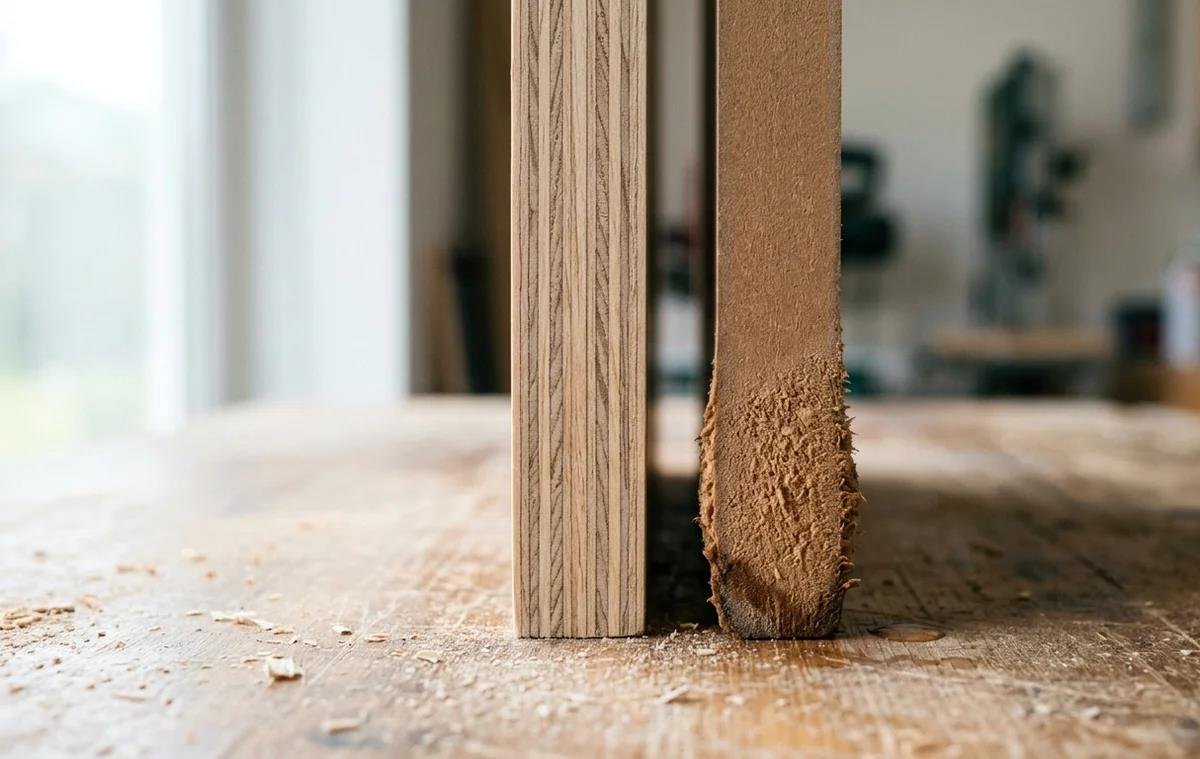
Plywood is thin veneers of real wood laminated together with the grain of each layer running perpendicular to the one beneath it. That cross-lamination is the entire point. Wood moves substantially across the grain and barely along it, so alternating the direction cancels most of the movement out.
MDF is wood fibre broken down and recombined with resin under pressure into a homogeneous panel. It has no grain and therefore no grain direction, which means it has no preferred axis of movement at all.
Both are engineered products. Neither is a compromise version of solid wood, and in a cabinet box, solid wood would be the wrong choice anyway.
Seasonal humidity swings: MDF does slightly better
This surprises people. Across a normal Ontario year, with no liquid water involved, MDF is the more dimensionally stable of the two. Because the fibres are randomly oriented and resin-bound, it expands and contracts very little and does so uniformly. A wide MDF panel in a heated winter house will not develop the small internal stresses that a layered panel can.
Plywood is close behind and perfectly adequate. Its movement is small and predictable. Where it can misbehave is at the veneer faces, particularly on lower-grade panels with voids in the core, where repeated cycling occasionally shows as a lifted edge on a face veneer.
If the only variable were ambient humidity, this would be a narrow win for MDF.
Liquid water: plywood wins decisively
Ambient humidity is not the real threat. The real threat is water in its liquid form, and in a kitchen it arrives in specific, predictable places.
Under the sink, from a supply line weep or a drain fitting that loosens over years. Along the side panel next to a dishwasher, from steam escaping the door seal. At the toe kick, from mopping. Along the back of a cabinet on an exterior wall, from condensation where a cold wall meets warm humid interior air, which in an older uninsulated Toronto wall assembly is not unusual.
This is where the two materials separate.
Plywood absorbs water and swells in thickness. When it dries, it largely returns. The veneers may show some roughness and the finish may be compromised, but the panel remains structurally a panel. It also keeps holding screws.
MDF absorbs water at exposed cut edges and swells irreversibly. The fibres take up moisture, expand, and the resin bond does not restore the original density when things dry out. The classic symptom is a soft, mushroom-shaped bulge at the bottom of an under-sink panel that no amount of drying reverses. Once it has happened, the fix is replacement.
Particleboard, worth mentioning for contrast, behaves like MDF but worse, because its larger chips and lower density give water more to work with.
The screw question
Cabinets get taken apart. Hinges get replaced, drawer runners get upgraded, a damaged panel gets swapped after fifteen years.
Plywood accepts a screw into the same hole a second and third time and still holds. MDF holds a screw very well the first time and progressively less well after that, because the fibre around the thread crushes rather than compressing. On a hinge that has been adjusted and removed a few times, this is the difference between a door that sits right and a door that sags.
A practical specification
Nobody has to choose one material for the entire kitchen, and the better shops do not.
- Base cabinets, and especially the sink base: plywood. This is where water goes and where weight sits.
- The panel adjacent to the dishwasher: plywood, with a heat and moisture shield.
- Upper cabinets: either. They are dry and lightly loaded. MDF or particleboard here is a sensible economy, not a corner cut.
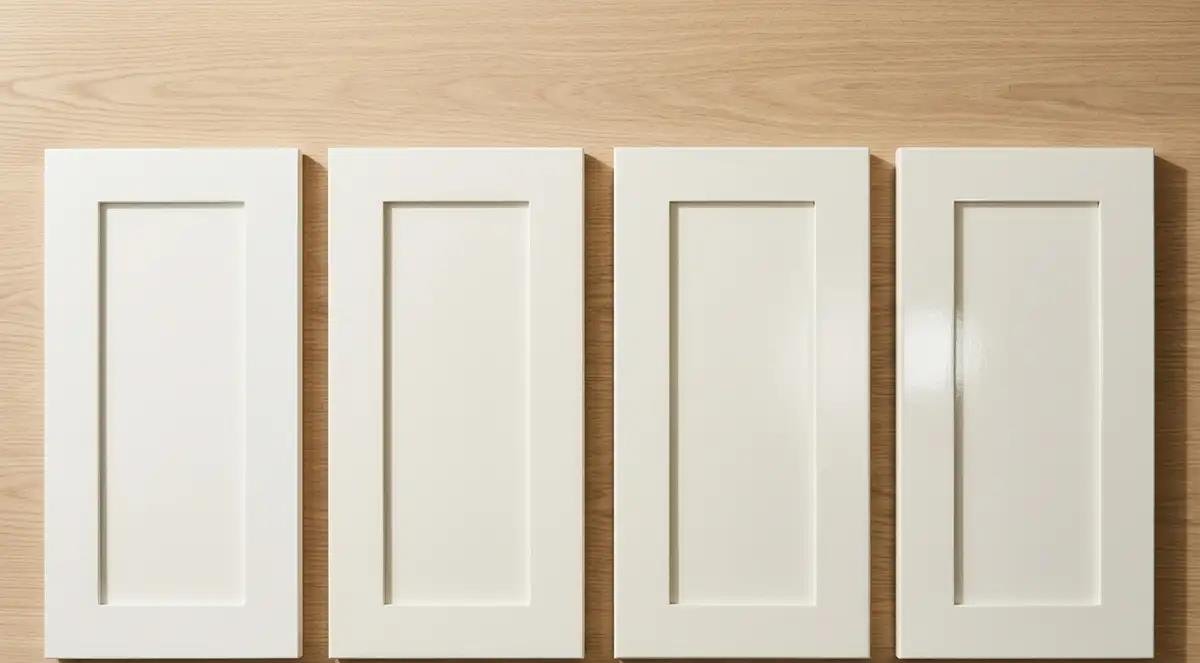
- Painted doors: MDF, and it is the better choice. No grain telegraphing, no seasonal hairline at the joints, a flatter painted surface than solid wood will give.
- All exposed cut edges, whichever material: sealed and edge-banded. An unsealed MDF edge inside a base cabinet is the single most common preventable failure in a modern kitchen.
The finish is doing more work than people credit
Whatever the substrate, what sits on top of it determines how much of the surrounding air and water ever reaches it. A well-cured finish is a moisture barrier as much as it is a colour. A rushed one is neither, and it is the reason two kitchens built from identical panels can age very differently.
If you are working through this decision, the finish options are worth comparing side by side alongside the material choice rather than after it, because the pairing matters more than either one alone.
The variable nobody specifies
Keeping indoor relative humidity somewhere between roughly 35 and 50 percent year round does more for cabinet longevity than any material upgrade. A winter humidifier setpoint and a working range hood that actually vents outside are cheaper than plywood everywhere, and they protect the flooring and trim at the same time.
Materials determine how much abuse a kitchen can absorb. Humidity control determines how much abuse it receives.