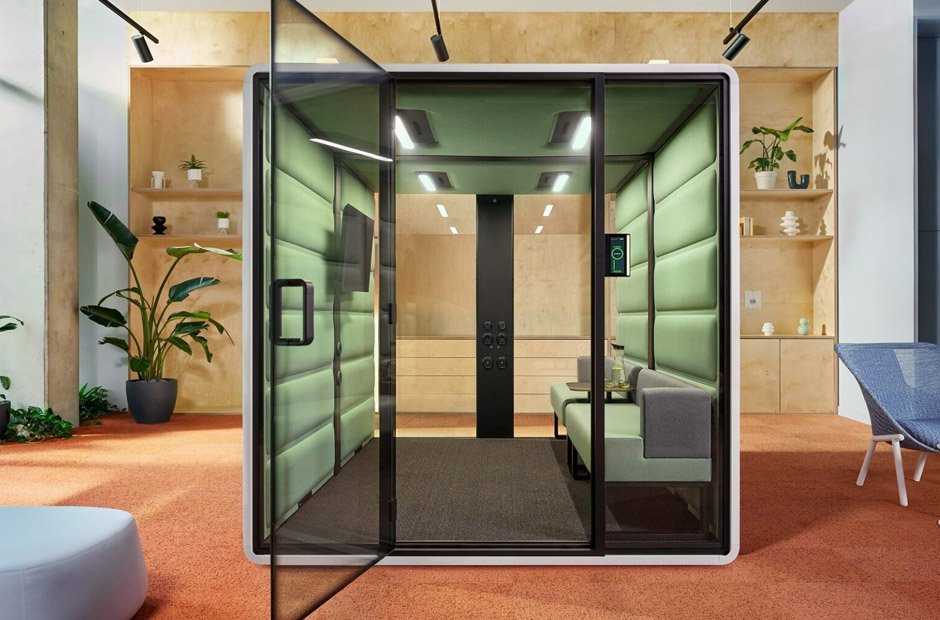
The productivity industry has sold us countless solutions. Time management apps, standing desks, specialized notebooks, focus techniques, morning routines, elaborate planning systems. We’ve been told that working smarter requires sophisticated methods, complex tools, and disciplined habits. Yet one of the most powerful productivity interventions turns out to be remarkably simple: four walls and a door.
Across industries and roles, workers are discovering that access to enclosed spaces transforms their output in ways no app or technique ever could. The impact is so significant that organizations are redesigning entire facilities around this realization.
The Rediscovery of Enclosure
The shift back toward enclosed spaces didn’t happen overnight. Organizations first tried compromise solutions: noise-canceling headphones, designated quiet hours, work-from-home days. These helped but addressed symptoms rather than causes.
Acoustic booths emerged as a middle path. They provided enclosure without permanent construction. They could be added to existing floors without major renovation. Most importantly, they gave workers the ability to control their immediate environment.
The impact exceeded expectations. Workers integrated these spaces into daily routines. The quiet rooms became essential infrastructure, as important as computers or internet access.
The Psychology of Boundaries
There’s something psychologically powerful about a door you can close. It creates a clear boundary saying “I’m unavailable right now.”
First, it provides permission. In an open office, focusing intensely on solo work can feel antisocial. A closed door eliminates this social ambiguity. Everyone understands closed doors signal focus time.
Second, it provides protection. You’re blocking the visual distraction of movement, social pressure of eye contact, and ambient awareness of other people’s activities. Your attention can fully commit to your task.
Third, it provides psychological safety. Difficult conversations become possible when you won’t be overheard. Creative exploration feels safer when you’re not performing for an audience.
The Design Evolution
Early implementations often treated quiet spaces as afterthoughts. As organizations recognized their value, design became more intentional. New offices now plan quiet spaces as essential infrastructure from the beginning.
The design of spaces themselves has evolved. Better ventilation prevents stuffiness. Improved lighting reduces eye strain. Comfortable furniture acknowledges extended use. Power outlets ensure technology functionality.
The Productivity Superpower in Practice
The most successful productivity interventions reduce friction. Four walls and a door accomplish this elegantly. Want to focus? Close the door. Need to minimize distraction? Step into a quiet space.
This simplicity is the superpower. There’s no learning curve, no habit to build, no technique to master. The environmental change itself does the work. You become more productive because the environment finally supports what you’re trying to accomplish.
Looking forward, the lesson is clear. Productivity isn’t just about individual techniques or technological tools. It’s also about environmental fit. The most productive workers aren’t necessarily the most skilled or motivated; they’re the ones whose environment matches their work requirements.
Four walls and a door won’t solve every productivity challenge. But for knowledge workers whose effectiveness depends on sustained focus, they might be the most impactful intervention available. Sometimes the best solutions are the simplest ones, and sometimes productivity superpower tools have been hiding in plain sight all along.