Walk into any big-box hardware store in the spring and you will find a wall of shed kits stacked in flat boxes, promising storage bliss for a few hundred dollars. It looks like a deal until you get the box home, spend an entire weekend wrestling with instructions written in six languages, and realize the panels are thinner than the cardboard they shipped in. Meanwhile, your neighbor has a handcrafted building in the backyard that has survived fifteen New England winters without so much as a sagging hinge.
If you have been browsing listings for sheds for sale and wondering why some cost three times more than others, the answer usually comes down to how they were built and who built them. Amish-built sheds have earned a reputation for longevity that box store kits simply cannot match, and the reasons go deeper than clever marketing.
The Difference Starts With the Wood
Most big-box shed kits are built around cost efficiency. Manufacturers know the shed has to survive the trip from the factory, not necessarily the next decade in your backyard. That is why so many kits use oriented strand board (OSB), sometimes called particle board by frustrated owners, for walls, floors, and roof sheathing. OSB performs reasonably well when it stays perfectly dry. The problem is that sheds live outside, where dry is a seasonal condition rather than a guarantee.
Once moisture works its way into OSB, it swells, crumbles, and loses structural integrity. You have probably seen this at a friend’s house. The floor feels spongy near the door, or the roof decking sags between rafters after a few wet winters.
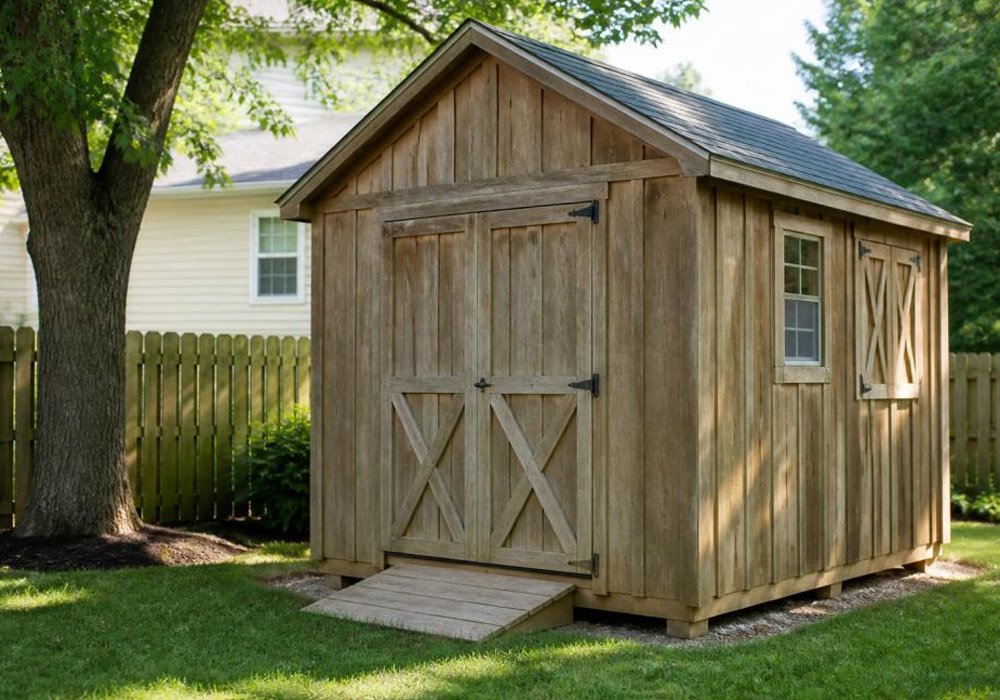
Traditional Amish builders typically use solid sawn lumber for framing and real wood siding, such as pine or cedar boards, on the exterior. Solid lumber handles moisture cycles far better than engineered sheet goods. A board can get wet, dry out, and get wet again for years without falling apart. Sheet goods get one or two chances before they start to fail.
Framing That Actually Holds Weight
Here is a detail most kit buyers never think about until it is too late: stud and joist spacing. Many mass-produced kits space their framing members 24 inches apart, or worse, rely on thin metal brackets to hold everything together. It saves the manufacturer money on lumber. It also means the floor system flexes under a riding mower and the walls rack back and forth in a strong wind.
Amish-built sheds generally use closer framing spacing, often 16 inches on center, with joists sized for real storage loads rather than the bare minimum. The difference is something you can feel the moment you step inside. A well-built shed floor feels like a porch, not a trampoline.
The fastening methods matter too. Traditional builders rely on nails and screws driven by hand-held tools, with attention paid to how each piece connects to the next. Kit manufacturers lean on staples and adhesives because a machine can apply them faster than a person can swing a hammer. Staples hold fine for a while. Then the seasonal expansion and contraction of wood works them loose, one by one, until siding panels start to gap and roof edges begin to lift.
Built by People Who Answer for Their Work
There is a cultural component to Amish craftsmanship that is hard to replicate on an assembly line. In Amish communities, a builder’s name is tied directly to every structure that leaves the shop. Word travels fast in a small town. A shed that leaks or a door that fails within two years is not a warranty claim, it is a personal embarrassment.
That accountability shows up in the details. Doors are hung with heavy-duty hinges and fitted so they close squarely. Windows are installed with proper flashing. Trim is cut to meet cleanly at the corners instead of being slapped on with a gap that invites water. None of these details make the product catalog. All of them determine whether the shed looks solid in year ten or looks like a candidate for the burn pile.
A factory worker assembling kit number 4,000 of the week has no such relationship to the finished product. The work is not bad, exactly. It is simply optimized for speed and cost, and those two priorities rarely align with durability.
Fully Assembled Versus Assembled by You
Big-box kits ship flat for a reason. Flat boxes fit in delivery trucks and can be stored in warehouses cheaply. The trade-off is that the final quality of the building depends on whoever wields the screwdriver on delivery day, which is usually you, on a Saturday, with a helper who would rather be fishing.
Even a well-engineered kit suffers in amateur hands. Panels get forced slightly out of square. Weatherstripping gets installed backwards. Roof seams end up misaligned by half an inch, which is exactly enough to let wind-driven rain under the shingles for the next five years.
Amish-built sheds are typically delivered fully assembled, constructed in a shop under controlled conditions by people who build the same structures every day. The building arrives as a finished product, set and leveled on your site, ready to use. The workmanship was locked in before the truck ever pulled into your driveway.
The Real Cost Math
Upfront price is where kits win the argument, at least on paper. A vinyl-sided kit might cost half of what a comparable handcrafted shed runs. But cost per year of ownership tells a different story.
A quality shed that lasts 20 to 30 years with basic maintenance averages out to a modest annual expense. A kit that needs a new floor in year six, replacement doors in year eight, and a full tear-down in year twelve ends up costing more per year of service, especially once you add your own weekend labor at both ends of its life.
There is also the effect on your property. A well-proportioned wooden shed with clean lines and fresh paint adds curb appeal. A sagging kit with delaminating siding does the opposite. Real estate agents in many markets will tell you that a quality outbuilding is a selling point, while a deteriorating one is a line item on a buyer’s inspection request.
How to Spot Quality Before You Buy
Whether you end up with an Amish-built structure or another option, a few inspection tips will serve you well. Look at the floor joists and ask about spacing and lumber size. Press on the wall siding and see whether it flexes. Open and close the door a few times and watch how the frame responds. Ask what material the roof sheathing is made of. Ask whether the building comes painted or whether you are expected to handle that yourself.
Any builder proud of their work will happily answer those questions. Hesitation is information.
The Long Game
Storage is not a purchase most people make twice in a decade, which is exactly why it deserves a little extra thought the first time. Big-box kits fill a role, and for someone who needs cheap, temporary storage, they can make sense. But for homeowners who want a building that quietly does its job through snow, heat, and the occasional nor’easter, traditional craftsmanship still earns its price.
The Amish approach to shed building has persisted for generations for a simple reason. Solid lumber, tight framing, careful joinery, and personal accountability produce structures that outlast trends, warranties, and quite possibly the homeowner who bought them. That is not nostalgia. That is just good construction.